- Contemporary Manufacture
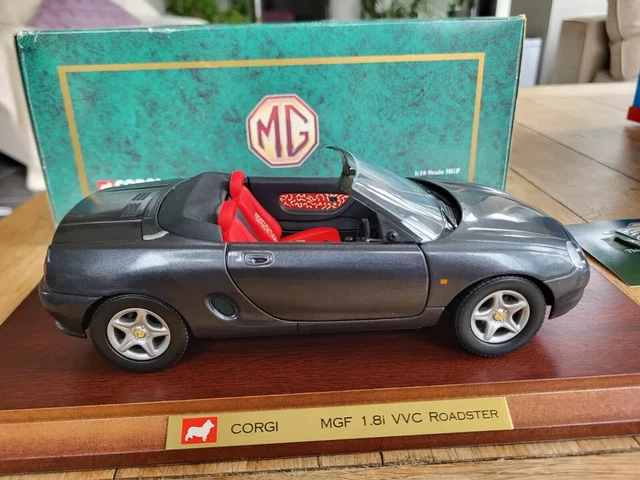
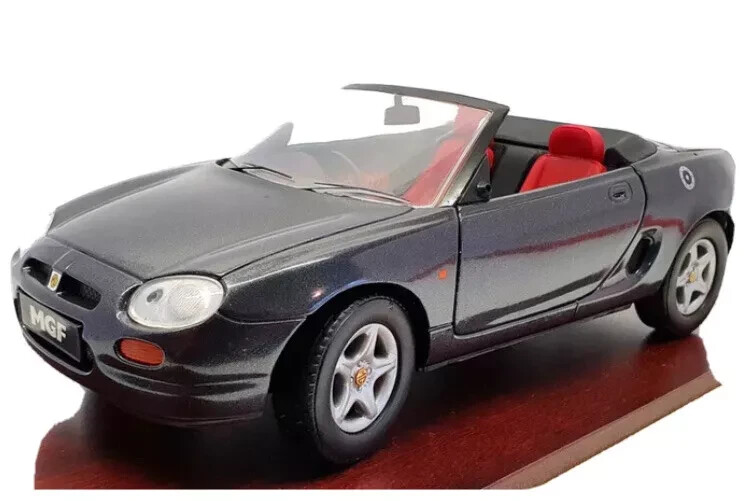
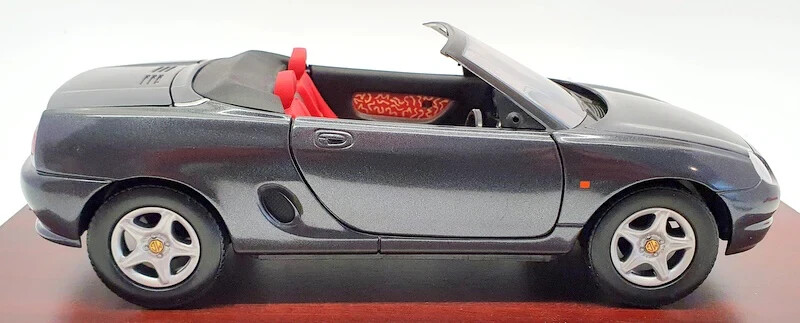
1:18 Scale Corgi MG Roadster Grey Model Sports Car Toy Wooden Plinth Display UK
See Details on eBayavailable at
£149.99 Buy It Now or Best Offer, £5.99 Shipping, 30-Day Returns, eBay Money Back Guarantee
Seller: checkoutmyunqiuefunitems ✉️ (4,885) 99.7%, Location: Manchester, Take a look at my other items, GB, Ships to: WORLDWIDE, Item: 276874933438 1:18 Scale Corgi MG Roadster Grey Model Sports Car Toy Wooden Plinth Display UK. Doty 2000c, p. 88. The adult collector. Doty 2000a, pp. 88–89. Lehto 2010, pp. 89, 101. Ragan 2000, p. 6. Ligier logo. 151A Lotus XI. Competition models. Corgi MG Roadstar 1:18 Scale Model Car on Wooden Plinth Stand This is a rare 1;18 Scale Corgi MG MGF 1.8i VVC Roadster Model Car Limited Edition Metallic Grey #95105 Mounted on Wooden Plinth Stand Complete with Metal Sign The MG car brand is known for its quality, and this Corgi Classics Series model is no exception. The grey metallic finish is a stunning addition to the car's pressed steel body, and it features realistic details such as functioning doors. This car is perfect for display and play, and is a must-have for any car enthusiast. Side Doors and Boot Open Explore the timeless elegance of the Corgi MG Roadster, a 1:18 scale replica that captures the essence of classic sports cars. Finished in a sleek grey hue, this model is a testament to the MG's storied heritage, complemented by the detailed craftsmanship synonymous with the Corgi Classics series. The car is presented on a wooden plinth, enhancing its display appeal and making it a sophisticated addition to any collection. This limited edition piece, manufactured in the United Kingdom in 1995, is not only a toy but also a collectible that celebrates the artistry of the Corgi brand. It resonates with enthusiasts of all ages, from young children to seasoned collectors. The model's durability is ensured by its metal construction, ensuring it remains a treasured item for years to come. From a Pet Free Smoke Free Home A Beautiful coin and Magnificent Keepsake Souvenir to Mark an amazing moment in time Would make an Excellent Gift or Collectable Keepsake souvineer of a great man Sorry about the poor quality photos. They don't do the coin justice. A lot of my buyers tell me the coin looks better in real life than in my photos In Excellent Condition I always combined postage on multiple items I have a lot of Trump Coins on Ebay so Please CLICK HERE TO VISIT MY SHOP Bid with Confidence - Check My 100% Positive Feedback from over 900 Satisfied Customers I always combine items and discount postage on multiple I Specialise in Unique Fun Items So For that Interesting Conversational Piece, A Birthday Present, Christmas Gift, A Comical Item to Cheer Someone Up or That Unique Perfect Gift for the Person Who has Everything....You Know Where to Look for a Bargain! Be sure to add me to your favourite sellers list All Items Dispatched within 24 hours of Receiving Payment and feedback let immedialtley as soon as payment received I always combined postage on multiple items so Click This Line to Check out my other items! All Payment Methods in All Major Currencies Accepted. All Items Sent out within 24 hours of Receiving Payment. For that Interesting Conversational Piece, A Birthday Present, Christmas Gift, A Comical Item to Cheer Someone Up or That Unique Perfect Gift for the Person Who has Everything....You Know Where to Look for a Bargain! Click Here to Add me to Your List of Favourite Sellers If You Have any Questions Please message me thru ebay a nd I Will Reply ASAP Thanks for Looking and Best of Luck with the Bidding!! I have sold items to coutries such as Afghanistan * Albania * Algeria * American Samoa (US) * Andorra * Angola * Anguilla (GB) * Antigua and Barbuda * Argentina * Armenia * Aruba (NL) * Australia * Austria * Azerbaijan * Bahamas * Bahrain * Bangladesh * Barbados * Belarus * Belgium * Belize * Benin * Bermuda (GB) * Bhutan * Bolivia * Bonaire (NL) * Bosnia and Herzegovina * Botswana * Bouvet Island (NO) * Brazil * British Indian Ocean Territory (GB) * British Virgin Islands (GB) * Brunei * Bulgaria * Burkina Faso * Burundi * Cambodia * Cameroon * Canada * Cape Verde * Cayman Islands (GB) * Central African Republic * Chad * Chile * China * Christmas Island (AU) * Cocos Islands (AU) * Colombia * Comoros * Congo * Democratic Republic of the Congo * Cook Islands (NZ) * Coral Sea Islands Territory (AU) * Costa Rica * Croatia * Cuba * Curaçao (NL) * Cyprus * Czech Republic * Denmark * Djibouti * Dominica * Dominican Republic * East Timor * Ecuador * Egypt * El Salvador * Equatorial Guinea * Eritrea * Estonia * Ethiopia * Falkland Islands (GB) * Faroe Islands (DK) * Fiji Islands * Finland * France * French Guiana (FR) * French Polynesia (FR) * French Southern Lands (FR) * Gabon * Gambia * Georgia * Germany * Ghana * Gibraltar (GB) * Greece * Greenland (DK) * Grenada * Guadeloupe (FR) * Guam (US) * Guatemala * Guernsey (GB) * Guinea * Guinea-Bissau * Guyana * Haiti * Heard and McDonald Islands (AU) * Honduras * Hong Kong (CN) * Hungary * Iceland * India * Indonesia * Iran * Iraq * Ireland * Isle of Man (GB) * Israel * Italy * Ivory Coast * Jamaica * Jan Mayen (NO) * Japan * Jersey (GB) * Jordan * Kazakhstan * Kenya * Kiribati * Kosovo * Kuwait * Kyrgyzstan * Laos * Latvia * Lebanon * Lesotho * Liberia * Libya * Liechtenstein * Lithuania * Luxembourg * Macau (CN) * Macedonia * Madagascar * Malawi * Malaysia * Maldives * Mali * Malta * Marshall Islands * Martinique (FR) * Mauritania * Mauritius * Mayotte (FR) * Mexico * Micronesia * Moldova * Monaco * Mongolia * Montenegro * Montserrat (GB) * Morocco * Mozambique * Myanmar * Namibia * Nauru * Navassa (US) * Nepal * Netherlands * New Caledonia (FR) * New Zealand * Nicaragua * Niger * Nigeria * Niue (NZ) * Norfolk Island (AU) * North Korea * Northern Cyprus * Northern Mariana Islands (US) * Norway * Oman * Pakistan * Palau * Palestinian Authority * Panama * Papua New Guinea * Paraguay * Peru * Philippines * Pitcairn Island (GB) * Poland * Portugal * Puerto Rico (US) * Qatar * Reunion (FR) * Romania * Russia * Rwanda * Saba (NL) * Saint Barthelemy (FR) * Saint Helena (GB) * Saint Kitts and Nevis * Saint Lucia * Saint Martin (FR) * Saint Pierre and Miquelon (FR) * Saint Vincent and the Grenadines * Samoa * San Marino * Sao Tome and Principe * Saudi Arabia * Senegal * Serbia * Seychelles * Sierra Leone * Singapore * Sint Eustatius (NL) * Sint Maarten (NL) * Slovakia * Slovenia * Solomon Islands * Somalia * South Africa * South Georgia (GB) * South Korea * South Sudan * Spain * Sri Lanka * Sudan * Suriname * Svalbard (NO) * Swaziland * Sweden * Switzerland * Syria * Taiwan * Tajikistan * Tanzania * Thailand * Togo * Tokelau (NZ) * Tonga * Trinidad and Tobago * Tunisia * Turkey * Turkmenistan * Turks and Caicos Islands (GB) * Tuvalu * U.S. Minor Pacific Islands (US) * U.S. Virgin Islands (US) * Uganda * Ukraine * United Arab Emirates * United Kingdom * United States * Uruguay * Uzbekistan * Vanuatu * Vatican City * Venezuela * Vietnam * Wallis and Futuna (FR) * Yemen * Zambia * Zimbabwe and major cities such as Tokyo, Yokohama, New York City, Sao Paulo, Seoul, Mexico City, Osaka, Kobe, Kyoto, Manila, Mumbai, Delhi, Jakarta, Lagos, Kolkata, Cairo, Los Angeles, Buenos Aires, Rio de Janeiro, Moscow, Shanghai, Karachi, Paris, Istanbul, Nagoya, Beijing, Chicago, London, Shenzhen, Essen, Düsseldorf, Tehran, Bogota, Lima, Bangkok, Johannesburg, East Rand, Chennai, Taipei, Baghdad, Santiago, Bangalore, Hyderabad, St Petersburg, Philadelphia, Lahore, Kinshasa, Miami, Ho Chi Minh City, Madrid, Tianjin, Kuala Lumpur, Toronto, Milan, Shenyang, Dallas, Fort Worth, Boston, Belo Horizonte, Khartoum, Riyadh, Singapore, Washington, Detroit, Barcelona,, Houston, Athens, Berlin, Sydney, Atlanta, Guadalajara, San Francisco, Oakland, Montreal, Monterey, Melbourne, Ankara, Recife, Phoenix/Mesa, Durban, Porto Alegre, Dalian, Jeddah, Seattle, Cape Town, San Diego, Fortaleza, Curitiba, Rome, Naples, Minneapolis, St. Paul, Tel Aviv, Birmingham, Frankfurt, Lisbon, Manchester, San Juan, Katowice, Tashkent, Fukuoka, Baku, Sumqayit, St. Louis, Baltimore, Sapporo, Tampa, St. Petersburg, Taichung, Warsaw, Denver, Cologne, Bonn, Hamburg, Dubai, Pretoria, Vancouver, Beirut, Budapest, Cleveland, Pittsburgh, Campinas, Harare, Brasilia, Kuwait, Munich, Portland, Brussels, Vienna, San Jose, Damman , Copenhagen, Brisbane, Riverside, San Bernardino, Cincinnati and Accra Corgi Toys Article Talk Read Edit View history Tools From Wikipedia, the free encyclopedia For the Corgi independent company, see Corgi Classics. This article needs additional citations for verification. Please help improve this article by adding citations to reliable sources. Unsourced material may be challenged and removed. Find sources: "Corgi Toys" – news · newspapers · books · scholar · JSTOR (January 2018) (Learn how and when to remove this message) Corgi Toys Product type Die cast toy Owner Hornby (2008–present)[1] Country Wales, UK Introduced 1956; 69 years ago Related brands Dinky Husky Markets Worldwide Previous owners Mettoy (1956–84) Mattel (1989–95) Corgi Classics Ltd. (1995–2008)[1] Website corgi.co.uk Corgi Toys (trademark) is the brand name of a range of die-cast toy vehicles created by Mettoy and currently owned by Hornby,[2] after it acquired the Corgi Classics Limited Company in 2008.[3] The Mettoy ("Metal Toy") company was founded in 1933 by German émigré Philip Ullmann in Northampton, England, where he was later joined by South African–born German Arthur Katz, who had previously worked for Ullmann at his toy company Tipp and Co of Nuremberg. After dabbling for some years in the model car market, they decided to produce a range of die-cast toy vehicles as competition to Meccano's Dinky model cars, which had dominated the British market for many years. "Corgi Toys" were introduced in the UK in July 1956 and were manufactured in Swansea, Wales, for 27 years before the company went into liquidation. A management buy-out re-formed the company as Corgi Toys Limited in March 1984. In 1989, the management sold the Corgi brand to Mattel and the factory was retained under the name of "Microlink Industries Ltd". In 1995, Corgi regained its independence as a new company, Corgi Classics Limited, and moved to new premises in Leicester. The Corgi brand was acquired by Hornby in 2008.[2] The range was exported worldwide and sold in large numbers. Some of the best known and most popular models were of cars made famous in film and television such as the Batmobile, Chitty Chitty Bang Bang and James Bond's Aston Martin DB5 – which remains the largest selling toy car ever produced. Although the largest single vehicle type featured in the Corgi Toys range were models of cars from manufacturers around the world, this article sub-divides vehicles into genres, wherever possible, to allow a more detailed look at the variety of models produced by the company. Early history 204 Rover 90 and 205 Riley Pathfinder Mettoy became established in Northampton and within six years of the company's founding, the Northampton factory had 600 employees.[4] A production plant was built at Fforestfach in Swansea, South Wales, to manufacture the new range of Corgi Toys. This provided many new jobs in an area of high unemployment following the scaling down of local coal mining operations.[5] Prior to the introduction of Corgi Toys, Mettoy mainly produced tin plate toys. However, in the early 1950s, they began producing a few products in cast metal. The first was a large scale wind-up racer made with a cast aluminium body and tin plate wheels. The body material was soon changed to die cast zinc and it was refitted with cast wheels and moulded rubber tyres. Other models followed and the product line was given the name "Castoys." These were the direct ancestors of Corgi Toys. 305 Triumph TR3 The name 'Corgi Toys' was chosen by Philip Ullmann in honour of the company's new home, taken from the Welsh breed of dog, the Corgi, and the iconic Corgi dog logo branded the new range. The name was short and easy to remember, further aligning the range with their rival Dinky Toys. Corgi Toys also included plastic glazing,[6] which lent the models a greater authenticity, and they carried the advertising slogan "the ones with windows". The 1956 releases were all familiar British vehicles. Six family saloon cars; Ford Consul (200/200M), Austin A50 Cambridge (201/201M), Morris Cowley (202/202M), Vauxhall Velox (203/203M), Rover 90 (204/204M), Riley Pathfinder (205/205M) and Hillman Husky (206/206M),[6] and two sports cars; Austin-Healey 100 (300) and Triumph TR2 (301). Initially, models were issued both in free-rolling form, and (except the larger commercial vehicles and sports cars with low-slung bodies) with friction drive motors. The Mechanical versions, as they were known, were indicated by an 'M' suffix to the model number and were produced in different colour schemes. They were issued with tougher die-cast bases to support the extra weight of the motor. Mechanical versions did not sell as well as the free-rolling versions, partly due to a significantly higher purchase price, and were phased out in 1960 with Ford Thunderbird (214M) the last of the line. One particular problem that was not anticipated was that it was possible to lubricate the "motor" using oil through a hole in the base, but the oil tended to splatter around inside and cloud up the windows. The rigid die-case bases which were are originally limited to the "M" versions were retained and became the standard for Corgi toys. Expansion and innovation 309 Aston Martin DB4 Competition Model British cars dominated the releases at the beginning, reflecting the company's concentration on the home market, but by 1957 new markets were being explored and the first European car to be modelled was the Citroën DS19 (210) issued in December of that year. The first American car, the Studebaker Golden Hawk (211/211M), was released in February 1958 and by the early 1960s the Corgi range was being exported widely, finding particular popularity in Europe, Australia, Canada, the United States of America and areas of southeast Asia such as Singapore, Malaysia and Hong Kong, and gradually more foreign vehicles were included to appeal to these new markets. 241 Ghia L6.4 Models were issued on a monthly basis and the range grew quickly to include vehicles of all types. Gradually the models became more sophisticated with the addition of such features as 'Glidamatic' spring suspension and a detailed interior on the Renault Floride (222) in October 1959, and the fibre-optic style 'Trans-o-Lite' illuminating lights system first seen on the Superior Air-Ground Ambulance Service on Cadillac Chassis (437) in October 1962. The early type of interior which was known as 'vac-formed', was produced by stretching a thin sheet of acetate over a mould by means of a vacuum, and lasted for three years until being replaced by the crisper, more detailed injection-moulded type first seen in the Thames 'Airborne' caravan (420) in February 1962. 224 Bentley Continental The Corgi design team came up with the first model with an opening feature in February 1960, the Aston Martin DB4 (218) which had an opening bonnet. Steerable front wheels, jewelled headlights and rear lights and an opening boot complete with spare wheel were added on the Bentley Continental Sports Saloon (224) in April 1961, and by October 1963 with the release of the Ghia L6.4 (241) new levels of authenticity were reached. This model featured a number of 'firsts' with not only an opening bonnet, but also opening doors and boot, and a detailed interior with a rear view mirror, folding front seats, and even a model corgi dog sitting on the rear parcel shelf. At introduction, the Ghia sold for eight shillings and sixpence, and even at this relatively high price around 1.7 million were sold before being withdrawn in 1969. By contrast, only twenty five examples of the real car were completed![7] Another popular model was the Jaguar Mark X (#238; 1962–1967) — over 1.1 million were sold, and hardly any other model was released in as many colours.[8] In 1964, Mettoy introduced a range of smaller scale vehicles called Husky Toys. These retailed at a lower retail price and were available exclusively through F.W.Woolworth & Co, and were designed to venture into the market dominated for many years by Lesney's Matchbox range. Corgi Classics In 1964 Corgi diversified into the adult collector market and released a range of highly detailed models of vintage cars called 'Corgi Classics'. Marketed at a higher price point than Lesney's Matchbox 'Models of Yesteryear', they met with mixed success. Initial releases were a 1927 Bentley finished in green (9001) or red (9002), an open 1915 Ford Model T coloured black (9011) and yellow (9012), and a version finished in blue with the hood raised (9013), a 1910 Daimler 38 finished in red (9021) and a 1911 Renault 12/16 finished in lavender (9031) or pale yellow (9032). Two years later, a 1912 Rolls-Royce Silver Ghost coloured silver (9041) was added to the range, which was updated in 1970 to feature American TV stars The Hardy Boys, discussed later in this article. A Ford Model T van in Lyons Tea livery (9014) appeared in the 1967 Corgi catalogue but was never released. The Corgi Classics range was discontinued in 1969, although the name was later revived for a range of adult collectable models in the 1980s. Corgi Major Toys Following the success of the Dinky Supertoys range of die-cast trucks, Corgi decided to launch a range of heavy commercial vehicles in October 1957 with the release of the Carrimore Car Transporter (1101) featuring a Bedford S-Type tractor unit with full glazing in keeping with the rest of the Corgi range, and the company's first gift set including the Carrimore Car Transporter and four cars (GS1); Austin Cambridge (201), Jaguar 2.4 (208), Austin-Healey (300) and MGA (302) in time for the Christmas market in December 1957. Early models in the new 'Corgi Major' range were issued in sturdy two piece boxes featuring the blue and yellow colour scheme that had recently been adopted across the entire Corgi range, later models in the 1960s using clear fronted packaging in line with the rest of the Corgi Toys range. The Carrimore Low Loader (1100) was the next release in April 1958 which was a low loader trailer attached to the Bedford cab and was followed by the similar Machinery Carrier low loader (1104) in September 1958. In November 1958 the Euclid TC12 Bulldozer (1102) was issued. A large earth mover which was being widely used in the construction of the M1, the UK's first motorway, the Euclid factory was only two miles from Corgi headquarters which allowed easy access to all the data required to produce a very accurate model. April 1959 saw the release of the Bedford Fuel Tanker in the red livery of 'Mobilgas' (1110) and this model was revamped in pale blue and white as the Bedford Milk Tanker (1129) in May 1962, and both were later re-issued with a more modern Bedford TK cab. The Midland Red Motor Express Coach (1120), issued in March 1960, was a model of the latest high speed coach for the motorway age fitted with a turbo-charged engine and capable of 100 mph, and a model of the pioneering SR.N1 hovercraft (1119) was released in June 1960. In November 1962 the new Bedford TK cab unit was also fitted to the existing Carrimore Car Transporter (1105) and was also included in a new Car Transporter Gift Set (GS28) in December 1963 along with four cars; Ford Consul Classic (234), Mercedes-Benz 220 SE (230), Renault Floride (222) and Fiat 2100 (232). The Ecurie Ecosse Racing Transporter (1126) issued in October 1961 was a racing car transporter custom built for the Scottish motor racing team Ecurie Ecosse, with room for three cars and an on-board workshop. The Corgi model featured operational ramps, a sliding door revealing the workshop complete with a miniature lathe, operational steering, and was finished in authentic dark blue. Racing Transporter Set (GS16) was also released in October 1961 featuring the Ecurie Ecosse transporter along with three racing cars; Vanwall (150), BRM (156) and [Lotus XI] (151). The Simon Snorkel Aerial Rescue Truck (1127) was issued in September 1964. This model fire engine was based on a Bedford TK chassis and featured an extendable centre-hinged arm with rescue cradle complete with fire fighter figure holding a die-cast water cannon which could be manoeuvred by means of a rotating base and wheels and gears. The model stayed in the range until being updated with a more modern Dennis cab (1126) in June 1977. 1142 Holmes Wrecker Recovery Vehicle A new cab unit was introduced in September 1965. The Ford H Cab and Detachable Trailer (1137) was an American truck produced by Corgi to appeal to the lucrative US market and featured a forward tilting cab revealing a highly detailed engine, realistic moveable door mirrors and die-cast metal air horns and side ladders. The large box trailer featured sliding side doors, opening rear doors and was finished in the blue and silver 'Express Services' livery. The leap in quality of this model proved that the Major range had entered a new era, and it continued to sell well until 1972. The new Ford cab was used again in April 1966 with a new version of the Carrimore Car Transporter (1138) which had been re-designed to carry up to six Corgi cars, and which also featured in Gift Set 41 along with six cars; Ford Cortina Estate (440), Rover 2000 (252), Hillman Imp (251), Mini Cooper De-Luxe (249), Austin Seven (225) and Mini Cooper Monte Carlo 1966 (321). This gift set was initially only available by mail order but was finally issued in time for Christmas in December 1967. The Holmes Wrecker Recovery Vehicle (1142) issued in May 1967 was also based on the Ford H series tractor unit, and featured twin boom die-cast recovery cranes with hooks attached to cotton lines that could be extended by winding a pair of spare wheels attached to the sides of the vehicle, and also included were two model mechanics previously seen with the 'Express Services' truck. The American LaFrance Aerial Rescue Truck (1143) was added to the Major range in October 1968 and was a highly detailed model of a tiller/ladder truck (or hook and ladder) from the United States of America. It featured an extendable ladder on a rotating base complete with plastic ladder extensions and model firemen and has recently been re-issued by the modern Corgi company in a number of authentic liveries. The Carrimore Car Transporter Mark IV using the recently introduced Scammell cab was also released in April 1969 and a gift set (GS48) featuring the new transporter and six cars; MGC GT (345), Mini Cooper Monte Carlo 1967 (339), Sunbeam Imp Monte Carlo 1967 (340), Mini Cooper S Magnifique (334), Morris Mini Minor (226) and The Saint's Volvo P1800 (258) soon followed. By October 1970 the Carrimore Car Transporter Mark V (1146) had grown to three decks and Gift Set 20 again featured the transporter complete with six cars now fitted with Whizzwheels; Lancia Fulvia Zagato (372), Marcos 3 Litre (377), MGC GT (378), Ford Capri 3 Litre (311), The Saint's Volvo P1800 (201) and Pontiac Firebird (343). The colour schemes applied to some cars in the Car Transporter Gift Sets were unique to models included in these sets, such as the MGC GT (345) finished in orange, and today are particularly collectable. The Scammell Handyman Ferrymasters Truck (1147) issued in December 1969, proved to be the last new application for the Scammell cab and was finished in the authentic yellow and white livery of the Ferrymasters haulage company. The Major range continued into the 1970s but along with the Corgi Toys range suffered somewhat from the constraints on development budgets that the company was forced to make. The Mercedes-Benz Unimog and snowplough (1150) was released in February 1971 and another American cab unit was introduced in October 1971. The new Mack was coupled with a fuel tanker in the livery of "Esso" (1152) in October 1971 and a Transcontinental trailer (1100) in November 1971, and fitted with an updated version of the Priestman Cub Shovel now converted to become a crane in October 1972 as the Mack Priestman Crane Truck (1154). 1160 Corgi Major Ford Transcontinental tank truck Gulf from 1976 A new Berliet cab was introduced in May 1974 as the Crane Fruehauf Discharge Dumper (1102), a large articulated aggregate carrier for use on construction sites, and the new cab was also used as the Berliet Wrecker Truck (1144) in March 1975 updating the aforementioned Holmes Wrecker, which had been in the range since 1967. The Pathfinder Airport Crash Truck (1103) released in September 1974 had won the Design Council Engineering Award for its manufacturer Chubb, and the Corgi miniature included an internal water tank allowing water to be squirted through die-cast water cannons by pumping a rubber bulb. Another new cab was introduced in April 1976: The Ford Transcontinental was designed for long range treks across the European continent and was first issued coupled to the fuel tanker previously seen with the earlier Mack cab, also in 'Esso' livery (1157) or "Gulf" livery (1160), and, later in February 1982, in the livery of "Guinness" (1169). Circus vehicle models The Chipperfield's Circus Crane Truck (1121) was the first of the highly successful and much sought after range of Chipperfield's Circus vehicles produced by Corgi Toys during the 1960s, and was issued in October 1960. It was based on a large International truck fitted with a metal crane, hook and pulley, and painted in the traditional Chipperfield's Circus livery of red and blue, as were all the models in the range. It was followed by the Circus Animal Cage Trailer (1123) in January 1961 which featured two two-part opening doors revealing a large cage with metal bars. These two models were later packaged together as the Chipperfield's Circus Set (GS12). An updated version of the Karrier Bantam Mobile Butcher Shop was introduced in January 1962 as the Circus Booking Office (426). The window insert of the original depicting joints of meat was replaced with a new one with circus advertising posters. In April 1962 the existing Land Rover 109 model was issued along with a trailer carrying a large cage and a model elephant as Chipperfield's Circus Land Rover and Elephant Cage on Trailer (GS19). The Chipperfield's Circus Vehicles Set (GS23) was issued in September 1962 featuring all the Chipperfield's models released to date, and today this is one of the most desirable gift sets issued by the company. The Chipperfield's Circus Horse Transporter (1130) was released in October 1962 featuring the new Bedford TK tractor unit and an articulated trailer with models of circus horses, and in June 1964 the Bedford TK tractor unit was adapted with a large high-sided open top 'wooden' box as the Giraffe Transporter (503) complete with models of a mother and baby giraffe. The Land Rover, which had been adapted as a 'Vote For Corgi' campaigning vehicle as a tie-in with the 1964 UK General Election, was re-issued in September 1965 in the red and blue colours of Chipperfield's as the Chipperfield's Circus Parade Vehicle (487) with a clown and chimpanzee replacing the political canvassers of the original, and a 'The Circus is Here' banner across the bonnet. The Chipperfield's Circus Menagerie Transporter (1139) which was released in October 1968 featured a new Scammell Handyman cab and a flatbed articulated trailer which carried a load of three clear plastic boxes designed to represent cages, each containing models of lions, bears and tigers. The Chipperfield's Circus Crane and Cage (1144), issued in April 1969, again featured the Scammell tractor unit but modified using the Holmes Wrecker platform with a large crane mounted on a pivoting base to the rear, and included another of the clear plastic animal cages with a model rhinoceros inside. The final model in the Chipperfield's Circus range was released in January 1970. The Chipperfield's Performing Poodles Pick Up (511) was an update of the earlier Kennel Club Wagon (itself an adaptation of the Chevrolet Impala first issued in 1960) and included model poodles and trainer. There were no further circus related releases until the Jean Richard Circus Set (GS48) which was issued in November 1978. This large set included models of the new 1/36 scale Land Rover Estate and Chevrolet Van which had been updated to become a parade vehicle and mobile booking office respectively. Also included were an animal cage trailer and models of horses and an elephant and figures of a clown and a ringmaster, together with various Big Top accessories. Another circus themed release was the Berliet tractor unit which had been adapted to become a human cannonball launcher complete with die-cast cannon attached to the rear and a human cannonball figure that could be fired from the cannon by means of depressing a button. Competition models 151A Lotus XI Throughout the company's history, Corgi Toys have been closely associated with modelling Grand Prix and Formula 1 racing cars. The first issued was the Vanwall Grand Prix car (150) issued in July 1957. Finished in green and carrying racing number 3, it was a scale model of the car driven by Stirling Moss. This was followed in December 1958 by a BRM Grand Prix car (106) also with green paintwork, and both cars featured in the Racing Car Set (GS5) from 1958, along with the Lotus XI Le Mans racing car (151) from July 1958. The Vanwall, however, had been re-coloured red. It was followed in December 1964 by the Lotus-Climax F1 car (155). Finished in an authentic British Racing Green and carrying racing number 1, it represented Jim Clark's 1963 world championship winning Lotus 25, and in 1967 it was joined by the Cooper-Maserati F1 car (156) painted blue. The Lotus-Climax and the Cooper-Maserati were re-engineered in 1969 to include steerable front wheels operated by moving the driver from side to side, and a high level rear wing in the style of real Formula 1 cars of the time. They were re-coloured orange in the case of the Lotus-Climax (158) and yellow in the case of the Cooper-Maserati (159). A Lotus Racing Car set (GS37) was issued in August 1966 containing the Lotus-Climax F1 car, two Lotus Elans and a Volkswagen breakdown tow truck. Another Ferrari was issued in February 1965, the Ferrari Berlinetta (314) (Ferrari 250 LM) which had competed at the 1964 Le Mans 24 Hour race, and in May 1967 another successful sports racer, the Porsche Carrera 6 (330) (Porsche 906), was released. In 1972 Corgi worked with the newly formed Grand Prix Association to produce a series of 1/36 scale Formula 1 racing cars. The first was the Yardley McLaren M19A (151) driven by New Zealander and 1967 World Champion Denny Hulme which was followed by the Brooke Bond Oxo Surtees TS9 driven by 1964 World Champion John Surtees (150), later followed by a Surtees TS9B in the livery of Italian sponsors 'Pagnossin', driven by Andrea de Adamich (153). These were the first models produced in the larger 1/36 scale instead of the familiar O scale preferred by Dinky and Corgi up to this date (varying between 1/43 to about 1/50 for larger vehicles). Within five years the whole Corgi range would be replaced by vehicles in 1/36 scale. 1973 saw the release of Jacky Ickx's Ferrari 312 B2 (152) and the John Player Special Lotus 72 (154) of World Champion (1972 and 1974) Emerson Fittipaldi or Ronnie Peterson, and in 1974 the Shadow F1 car was issued in both UOP livery (155) as driven by Jackie Oliver, and as Graham Hill's Embassy Shadow (156). Scottish multiple World Champion Jackie Stewart's Elf Tyrrell F1 car (158) was also released along with the STP Patrick Eagle (159) driven to victory in the 1973 Indianapolis 500 by Gordon Johncock. 153 Proteus-Campbell Bluebird The final two models in the series were the Hesketh 308 F1 car (190) driven by future English World Champion James Hunt issued in 1976, and the six wheeled Tyrrell Project 34 driven by Frenchman Patrick Depailler issued in Elf livery (161) in 1977 and First National City Travellers Checks livery (162) which was released in 1978. Two Formula 1 cars were also issued in 1/18 scale, the John Player Special Lotus 72 (190) in 1974 and the Marlboro McLaren (191) in 1975. The Proteus-Campbell Bluebird Record Car (153) was issued in September 1960 and was modelled on the vehicle with which Donald Campbell was to set a new Land Speed Record on 17 July 1964. The Corgi design team were given extensive access to the real car in order to produce their scale model, even receiving paint samples to enable them to create an exact colour match. However, a lighter blue was chosen for the model eventually. An example of the model was presented to Donald Campbell by young members of the Corgi Club. 475 Citroen DS Safari 1964 Winter Olympics & 499 Citroen DS Safari 1968 Grenoble Olympics Models following themes were released over the years. In January 1964, Corgi updated the existing Citroën DS Safari to become a promotional vehicle for the 1964 Winter Olympics (475), complete with a skier figure, four model skis and two model ski poles. Painted white and with a decal of the Olympic rings logo on the bonnet, this model then reverted to a 'Corgi Ski Club' version the following year. It was revamped again in November 1967 for the 1968 Winter Olympics (499), this time painted white with a blue roof, and with a model toboggan on the roof rack along with a figure of a tobogganist and a pair of skis and poles, and a stylish 'Grenoble Olympiade 1968' decal on the bonnet. The final version introduced in 1970 was an Alpine Rescue vehicle (510), painted white with a red roof and which came complete with figures of a St Bernard dog and rescuer, and today is the rarest of the versions. 340 Sunbeam Imp 1967 Monte Carlo Rally, 322 Rover 2000 1965 Monte Carlo Rally, 339 Mini Cooper S 1967 Monte Carlo Rally The Monte Carlo Rally, held annually in January, provided a rich source of model cars between 1964 and 1967. By following the event closely, Corgi Toys were able to issue a model of the winning car shortly after the end of the rally Often there was not even enough time to produce a unique box for the new model, which had to make do with a hastily produced sticker applied to a standard issue box for a similar model. The 1964 winner, Paddy Hopkirk's Mini Cooper S (317) released in February 1964, featured jewelled headlights and a rally lamp on the roof, and was finished in the BMC team colours of red with a white roof with authentic Monte Carlo Rally transfers. Three Monte Carlo Rally cars were issued in 1965, the winning Mini Cooper S of Timo Mäkinen (321) in February, finished in the same red with a white roof, and three jewelled rally lamps, and in April a Rover 2000 (322) in maroon with a white roof with two jewelled rally lamps in the grill and a Citroën DS21 (323) with four small jewelled rally lamps and finished in pale blue with a white roof complete with roof aerial. All three of these models were available in the Monte Carlo Gift Set (GS38) also issued in April 1965; a highly prized set for today's collector. Another Mini Cooper S in Monte Carlo Rally finish was issued the January of following year complete with two jewelled rally lamps in the grille and the signatures of the driver Timo Mäkinen and his co-driver Paul Easter printed on the roof. The model number 321 was carried over from the 1965 car. A Hillman Imp was also issued as a Monte Carlo Rally car (328), finished in blue with a white flash along the sides and two jewelled rally lamps, and was driven by an all-female team of Rosemary Smith and Valerie Domleo in the 1966 event. 1967 was the final year that Corgi issued Monte Carlo Rally cars, and the famous Mini Cooper S (339) appeared yet again in March, this time with four jewelled rally lamps in the grill, a sump guard and two spare wheels on a roof rack borrowed from the 'Surfing' Mini Traveller (485) from 1965. The 1967 Monte Carlo Rally Mini Cooper S stayed in the Corgi range until 1972, spanning two different castings. Another Mini Cooper S (333) was released in February 1967 carrying the same red and white paintwork, but as campaigned in the 1967 RAC/Sun rally by Tony Fall and Mike Wood, along with another Rover 2000 (322) from the same event finished in white with a matt black bonnet. The final rally car was the Sunbeam Imp (340) issued in March 1967, which featured four jewelled rally lamps and was finished in blue with a white flash and front panel. In December 1965 a Volkswagen 1200 Beetle was issued in East African Safari finish (256). This model featured an opening boot and engine cover and steerable front wheels operated by a spare tyre on the roof of the car. Three years later, in July 1969, Corgi issued the winning Hillman Hunter from the 1968 London to Sydney Marathon (302), complete with Take-Off Wheels, roof mounted tool box and a plastic kangaroo guard across the front of the car. This time the packaging included a model kangaroo and details of the event, and in February 1970 a model of the unique 4wd Ford Capri 3-Litre rally car (303) driven by Roger Clark was released. A model of the successful Datsun 240Z rally car in East African Safari Finish (394) was issued in October 1972 and in May 1973 the Datsun 240Z was also issued in "US Rally" finish (396). This, in fact, was an authentic model of John Morton's 300 bhp BRE-Datsun 240Z which won the 1970 and 1971 SCCA class C/P championships. The Ferrari 365GTB/4 Daytona as raced at the 1973 Le Mans 24 Hours race, with JCB and Corgi sponsorship (324), was released in June 1973 along with another in white/red/blue livery inspired by a 1972 Le Mans entry (323). In July 1973 the Porsche-Audi 917/10 (397) from the Can-Am race series was issued with L&M cigarette sponsorship. In the early 1970s Corgi Toys issued a range of dragsters in response not only to the increased interest in this form of motorsport in the UK, focused on the Santa Pod Raceway in Northamptonshire, but also the attention brought to these vehicles by Mattel's Hot Wheels. The first to be released was the 'Quartermaster' Dragster (162) in April 1971, closely followed by the 'Commuter' Dragster (161) in June. Both were models of real vehicles, and were of the 'rail' dragster variety. The first 'Funny Car' dragster was the Santa Pod "Gloworm" Dragster (163) issued in July 1971, and which was based on the existing Ford Capri 3-Litre casting. Modifications allowed the body to be hinged from the rear, and by pressing a button secreted in the front bumper the entire body rose, by means of a spring, to reveal a roll cage and driver within and a detailed V8 engine. The next release was a figment of the Corgi design team's imagination. The "Organ Grinder" Mustang Funny Car (166), which was issued in October 1971, was purely an update of the Ford Mustang (320) first seen in 1965, complete with huge rear wheels and headers resembling organ pipes fitted to the V8 engine. In December 1971 the Ison Brothers "Wild Honey" Dragster (164) was released which was a fully customised 'gasser' based on a 1930s Austin Seven saloon. The Adams Brothers "Drag-Star" (165) released in February 1972 was a four engined machine produced in conjunction with designers the Adams Brothers, and the earlier "Quartermaster" Dragster was updated in October 1972 as the John Woolfe Radio Luxembourg 208 Dragster (170). Film and television models 1960s Corgi Toys introduced the first of the many film and television tie-in models that made the company famous in March 1965, with The Saint's Volvo P1800 (258) from the British television series The Saint starring Roger Moore. This was an update of the existing Volvo P1800 model that had been issued in 1962, now finished in white and featuring The Saint's logo on the bonnet and a model of The Saint in the drivers seat. The Corgi executives were impressed by how The Saint version sold in much larger numbers than the regular version, despite the fact that on the TV there was no Saint's logo on the car. With the second in the range of film and TV related models Corgi revolutionised the British toy car industry. 270 James Bond Aston Martin DB5, second issue from 1968 produced by Corgi Toys as a tie-in to the film "Goldfinger" The most famous and best selling (to date) toy car of all, James Bond's Aston Martin DB5 (261) from the film Goldfinger, was issued in October 1965. Despite the fact that the casting of the new James Bond car was based heavily on the earlier Aston Martin DB4 model from 1960, it was the special features marked out this model. There were machine guns in the front wings which popped out at the touch of a button, a bulletproof shield which popped up to protect the rear screen when the exhaust pipes were pressed, and an ejector seat which fired through a roof panel which opened by the touch of another button. The model was released in time for the 1965 Christmas market and the Corgi factory found it was unable to keep up with demand, leading to coverage in the British press of stories of toy shop shelves being cleared of this new must-have toy in minutes. The model remains in production to this day in an updated form and has gone on to sell more than seven million examples in all its various versions. The "Thrushbuster" (497) was an update of an existing Oldsmobile Super 88 casting dating back to 1961, but now with models of the stars of the television series The Man from U.N.C.L.E., agents Napoleon Solo and Illya Kuryakin, firing guns out of the windows. The two figures popped in and out of the car windows by pressing down on a model periscope protruding through the roof.[9] Like in the case of The Saint, this owed little to realism - on the TV show the two heroes would certainly not advertize their affiliation with the logo on the bonnet. The Batmobile from the 1966 Batman TV series, one of the famous cars modeled by Corgi The Christmas market was again dominated by a Corgi toy car; this time the Batmobile (267) released in October 1966. This was a George Barris customised 1955 Lincoln Futura concept car bought by Barris as a wreck from Ford Motor Company (reputedly for one dollar) and which featured heavily in the American television series Batman. In June 1967 GS3 was issued consisting of The Batmobile towing a Batboat on a trailer, and another James Bond car soon followed – the Toyota 2000GT (336) issued in October 1967 from the film You Only Live Twice, which fired rockets from the boot. The previously issued 1927 Bentley was updated for a second time to tie in with the BBC television series The World of Wooster (9004) which starred Ian Carmichael and featured figures of Bertie Wooster and his valet Jeeves at the wheel. It was the only film and television related model issued as part of the Corgi Classics range and did not sell well. The final film and television related model for 1967 was issued in November. The crime fighting car Black Beauty (268) - a George Barris customised 1965 Imperial Crown sedan, included an operational satellite launcher inside the boot and a rocket fired from behind the grill, and was featured in the American television series The Green Hornet. Although the series was not screened in the UK until years later, the model proved to be very popular and it went on to sell over two million examples. A new casting of the James Bond Aston Martin DB5 (270) was released in February 1968, this time featuring the correct DB5 taillights (instead of the DB4 taillight clusters on the 261) and authentic silver paintwork. The original had been painted gold after the Corgi design team decided that silver painted pre-production models looked as if the metal bodies were unpainted. The new model now featured tyre slashers and revolving number plates whilst retaining all the features of the original, and early examples packaged in a short lived bubble-pack are even more valuable today than the earlier 1965 release. 277 Monkeemobile November 1968 saw the release of the flying car Chitty Chitty Bang Bang (266) from the successful film of the same name that had been in cinemas throughout that summer. It featured plastic wings that popped out from the car's side skirts when the hand brake was pushed and detailed miniatures of the car's inventor, Caractacus Potts, Truly Scrumptious and the children Jeremy and Jemima. The Monkeemobile (277) issued in December was a model of the Dean Jeffries customised 1966 Pontiac GTO that featured in the American television series The Monkees. It included miniatures of band members Davy Jones, Mickey Dolenz, Peter Tork and Mike Nesmith sitting in the car. 803 Yellow Submarine Film and television related models continued to be issued in February 1969 with the Yellow Submarine (803) from the animated Beatles film of the same name. This model featured two hatches that lifted at the touch of buttons on the side of the craft to allow models of the Fab Four John Lennon, Paul McCartney, George Harrison and Ringo Starr to pop into view. Early examples featured a white hatch to the front and a yellow hatch to the rear in keeping with the colour scheme of the original, before both hatches were coloured red on later models. The Yellow Submarine commands high prices today among both die-cast collectors and collectors of Beatles-related memorabilia. Corgi Toys not only produced models of automotive stars of film and television, but also models of production vehicles. A newly tooled Commer 2500 mini bus body was used for the Samuelson Mobile Camera Van (479) issued in December 1967 which included a detailed cast metal model of a Panavision film camera and plastic cameraman on a metal plinth that could be either attached to the vehicle's roof rack or to the front or rear of the van for tracking shots. The lens of the camera was represented by a tiny jewel. In September 1968 the Renault 16 Tour De France Paramount Film Unit (GS13) was released. This gift set featured a Renault 16 car with the tailgate removed and a platform extension fixed at the rear to accommodate the Panavision film camera model and cameraman. Also included was a miniature racing cycle and cyclist. 1970s The releases of film and television related models continued into the seventies, and included more James Bond models. In June 1970, the 1912 Rolls-Royce Silver Ghost from the Corgi Classics range was reissued, but updated with psychedelic paintwork and featuring figures of the group from the animated series The Hardy Boys, another American television show which was unknown in Britain. This time the model failed to sell, making it extremely rare today. A Ford Mustang Mach 1 (391) and the "Moon Buggy" (802) from the film Diamonds Are Forever were issued in 1972, and the Lotus Esprit (269) in 'underwater' mode from The Spy Who Loved Me in 1977. A rocket-firing 'Stromberg' Bell JetRanger helicopter (926) from the same film was added in 1978. The Space Shuttle (649) from the Bond movie Moonraker appeared in 1979 along with a 'Drax' JetRanger helicopter (930) from the same film. A Citroën 2CV which James Bond drove in the film For Your Eyes Only was issued in 1981. As the decade progressed some of the film and television related models became less authentic due to the lack of expensive licensing deals, and more a product of the imagination of the Corgi design team. In 1973 'Dick Dastardly's' Car (809) was issued featuring models of the characters 'Dick Dastardly' and his sidekick 'Muttley' from the children's television program Wacky Races. However, this Corgi offering was a toy-like race car from the 'Comics' range, and was a far cry from the famous "00-zero" car that 'Dick Dastardly' drove in the cartoon series. In 1978, since the Superman movie was already popular in the UK, Corgi introduced and took advantage of recently acquired licensing deal to make Corgi Toys (model no. 260,) Superman 'Metropolis Buick' as a diecast 1:36 scale replica of a 1974-1975 Buick Regal (round headlights) style sedan. This toy car was a 1979 trademark of DC Comics, Inc on the package with a cartoon Superman. The vehicle was blue and white stripes with Police and had the two front doors that would open. There were four beacons and four sirens on the roof and a City of Metropolis Police Dept emblem on the front hood. The packaging was designed for the English, French, and German markets. This was a prime example of using a car product that was not shown in the movie but using another car product from television's Kojak series, that was produced by Corgi in 1976, a blue 74 Buick Regal police car (260B1) with one beacon and a brown 74 Buick Regal detective car (290) with one beacon. That 'Kojak' series drove Buick Century's and not the upscaled Buick Regal's that Corgi made as authentic from the show. Further confusion in the market was the same blue Buick police car as Corgi (model no. 416) "Buick Century Police-Polizei" with one beacon was made in 1977 that included a police officer figure. The car was either a "Kojak" car, then police car, and then "Superman" as proof of reusing the diecast without authenticate to television or movies. The Metropolis police car of Superman, was a 1976 Plymouth Fury and there were no Buick police cars in the movie.[10] In 1978 the "U.S. Racing Buggy" (167) was reissued as 'The Penguinmobile', themed around Batman's arch-enemy The Penguin, complete with an umbrella. (259). A 'Batbike' was released in 1978 featuring a figure of 'Batman' sitting astride a modified motorbike which fired two rockets, along with a series of vehicles that were issued as the result of obtaining the Marvel Comics license. They were themed around Spider-Man, Captain America, Captain Marvel and The Incredible Hulk. These included a 'Spidervan' (436); a suitably decorated Chevrolet van, which had also been issued the previous year as a tie-in with the American television series Charlie's Angels (434), a "Daily Planet" JetRanger helicopter (929), a "Spiderbuggy" (261); a Jeep CJ-5 with a model of 'Spider-Man's' archenemy "The Green Goblin" trapped in a web styled plastic bag dangling from a crane fitted at the back of the vehicle, a "Spidercopter" (928) and a "Spiderbike" (266). A similar treatment was also given to other Marvel characters including a "Captain America" Jetmobile (263), a 'Captain Marvel' Porsche 917/10 Can-Am racer (262) and an 'Incredible Hulk' Mazda pick-up (264) which featured a caged model of the 'Hulk' on the flatbed of the truck. A "Superman" gift set (GS21) was released featuring a 'Supermobile', the Daily Planet helicopter and a Buick Regal police car, as well as a "Spider-Man" gift set (GS23) consisting of the "Spiderbuggy", the "Spidercopter" and the "Spidervan". Many of these later film and television related releases were not models of authentic vehicles as were the earlier issues from the 1960s, but merely existing models updated to take advantage of recently acquired licensing deals. In May 1978 a new version of the James Bond Aston Martin DB5 (271) was issued in 1/36 scale which featured the operational gimmicks of the 1965 original. This model appears in the Corgi range to the present day. In October 1978 The Saint's Jaguar XJS (320) was issued. This was a model of the latest Jaguar coupe as driven by Ian Ogilvy in the ATV television series The Return of the Saint and, again, was painted white and featured The Saint logo on the bonnet. In 1980, the 'Buck Rogers' Starfighter (647), from the series Buck Rogers in the 25th Century, was released, including figures of 'Colonel Wilma Deering' and robot 'Twiki'. A series of models featuring characters from Jim Henson's The Muppet Show were also issued in 1980. These included "Kermit's" car (2030), "Fozzie Bear's truck" (2031), "Miss Piggy's Sports Coupe" (2032) and "Animal's Percussionmobile" (2033). By the mid-1970s some of the most popular series shown on British television were American police dramas, and Corgi decided to model several of the vehicles featured in these shows. In 1976 the Buick Regal (290) from the series Kojak was issued, complete with figures of 'Lieutenant Kojak' and 'Detective Crocker' shooting from the rear seat, and a year later the Ford Gran Torino from Starsky & Hutch (292) was released also with figures of "David Starsky", "Ken Hutchinson", and a "suspect". In 1980, a silver Ford Capri 3.0 S (342) was issued as a tie-in with the popular British television crime drama The Professionals featuring models of 'Bodie', 'Doyle' and 'Cowley', as well as a 1957 Ford Thunderbird (348) from the American show Vega$ with 'Dan Tanna' at the wheel. 1982 saw the release of the Magnum, P.I. Ferrari 308 GTS (298). Cost-cutting at the time dictated that no figure was included. Emergency vehicle models 419 Ford Zephyr Motorway Patrol Car The first emergency vehicles produced by Corgi Toys were issued as part of the launch range in July 1956, and were based on the Bedford Utilicon light commercial. It was issued in red as a 'Fire Dept' vehicle (405M) and in green as an 'Army Fire Service' vehicle (405), both with a tin plate ladder attached to the roof of the vehicle. These were followed in June 1958 by the company's first police vehicle; a Riley Pathfinder patrol car (209), finished in black and with a die cast police sign fitted to the roof complete with siren and bell. In January 1959 a Jaguar 2.4 Fire Chief car (213) was added to the range, finished in red and with a nylon aerial, crest transfers on the front doors and the same cast sign as the Pathfinder but modified to read 'Fire Chief'. The first American emergency vehicle to be produced by Corgi Toys was the Chevrolet Impala State Patrol car (223) introduced in December 1959. It was painted black and featured a nylon aerial and 'State Patrol' stickers on the vehicle's front doors. An updated version finished in black and white was issued in 1965. 464 Commer Police Van By 1959 the M1, the UK's first motorway, had opened to the public and this prompted the introduction of a new breed of powerful police vehicle able to carry a large payload. The Ford Zephyr Motorway Patrol Car (419) was introduced in August 1960 and was finished in white with a plastic aerial fitted to the front wing, a blue light attached to the roof, a 'Police' decal on the bonnet and a vac-formed interior detailing rescue equipment in the luggage compartment and in June 1962 the Oldsmobile Super 88 County Sheriff car (237) was added to the range. Painted black and white it featured a red light fitted to the roof and 'County Sheriff' stickers on the doors. This model became the company's first million seller. The Superior Ambulance on Cadillac Chassis (437) introduced in October 1962 was from the latest generation of models and featured red and white paintwork, a working battery operated flashing light on the roof and four trans-o-lite fibre optic lights in each corner of the roof that flashed in unison with the main bulb. This model was re-issued in blue and white in 1966. In January 1963 the existing Chevrolet Impala was introduced as a Fire Chief car (439), painted red with a light on the roof, crests decals on the doors and a 'Fire Chief' transfer on the bonnet, and was also updated with a red and white finish in 1966. In June 1963 the Commer Police Van (464) was released, painted blue with a battery operated flashing light on the roof, barred side windows and 'County Police' transfers along the sides, and this model was also updated in 1967. An ambulance version (463) painted white was issued in February 1964. In October 1964 a Police Dog Handler Mini van (450) was introduced painted dark blue with 'Police' in white letters on the sides, a nylon aerial fitted to the front wing and came with models of the police dog handler and police Alsatian dog. The Volkswagen European Police Car (492) issued in May 1966 was finished in the green and white of the German police force, and carried 'Polizei' transfers on the doors. It featured steerable front wheels operated by the blue metal 'light' on the roof and two policemen sitting inside the vehicle, not to mention opening boot and rear engine cover. Another rear engined police car was introduced in May 1968, the Sunbeam Imp 'Panda' car (506). It was painted black and white initially but this colour scheme was soon changed to authentic 'Panda' car colours of pale blue with a white vertical centre section. 437 Superior Ambulance on Cadillac Chassis (second issue) In June 1970 a Porsche 911 Targa 'Polizei' car (509) fitted with Whizzwheels was released. It featured a colour scheme of white and red and was fitted with a blue light on an extension next to the door and a die-cast loud hailer on the engine cover. A rare Dutch issue of the model featured dayglo orange and white paintwork and the correct 'Rijkspolitie' livery as featured on the real vehicle. The Fire Bug (395) appeared in December 1971, and was based on a GP Beach Buggy fitted with fire fighting equipment. British police vehicles were well represented with the Police 'Vigilant' Range Rover (461) released in January 1972 and the Ford Cortina Police Car (402) released in August of the same year. Both models were finished in the contemporary white with red/blue side stripes, which would have been familiar to many motorists at the time. The Range Rover came complete with a model policeman and emergency road signs, while the Cortina was also released with 'Polizei' labels on the otherwise unchanged British car as an export model for the German-speaking countries. The remaining years that the company was in existence saw police cars based on such subjects as a Porsche 924 (430) and a Renault 5 (428), both in the white and black livery of the French Police nationale, a Mercedes 240D (412) and the Porsche 924 (430) in white and green of the German 'Polizei', and a blue Buick Regal (416) which had previously seen service as 'Kojak's' car. There was also a Metropolitan Police Land Rover and Horse box (GS44) complete with a model Police horse and rider, which was also available in Royal Canadian Mounted Police finish (GS45). 1982 the Ford Escort was released as a blue and white Police 'Panda' car (297). Ambulances were issued based on the Range Rover 'Vigilant' (482), a Mercedes-Benz W123 'Bonna' (406) in four different liveries for Scandinavian and German-speaking countries, and a Chevrolet Superior Ambulance (405). There appears, however, to have been a lack of fire fighting machinery released in this time, although the American LaFrance ladder truck and Simon Snorkel were still available along with the modern Chubb Pathfinder airport crash tender. Two models from this era do warrant attention. Riot Police Truck (422) released in September 1977 was a squat armoured military vehicle painted white and red with twin water cannons fitted to the rear, and perhaps reflected the turbulent times in Britain towards the end of the 1970s, and the Jaguar XJ12 Coupe which was released in December 1975 finished in the white and pale blue livery of the Coastguard (414), complete with die-cast light and twin foghorns on the roof. The model was updated as a police vehicle (429) in February 1978. In 1980 the first of the later 'Corgitronics' range was introduced: the HCB-Angus Firestreak (1001) with battery-operated siren and flashing red lights, complete with two figures in silver protective clothing. Commercial vehicles models ERF van with Moorhouses advertisements The first light commercial modelled by Corgi Toys was the Bedford CA van in Daily Express livery (403) and in 'KLG Plugs' livery (403M) which was part of the July 1956 range that launched the brand. The CA van was later released in the yellow and black livery of AA Services in May 1957 (408), in the black and silver livery of the Evening Standard (421) in June 1960 and in the yellow and blue livery of Corgi Toys (422) in October 1960. The first large commercial vehicles in the Corgi Toys range were the Commer Dropside lorry (452) and the Commer Refrigerated van finished the livery of Walls Ice Cream (453). The same large van body was used on the ERF 88G chassis to become the Moorhouses Van (459) in March 1958. Painted red and yellow it featured paper stickers on the sides advertising Moorhouses Lemon Cheese and Raspberry jam. The Karrier Bantam Lucozade Van (411) was introduced in August 1958 and featured a sliding plastic door, yellow paintwork and adverts for Lucozade energy drink on the side. This model was updated in May 1962 to become the Dairy Produce Van (435) now painted pale blue and white and with a 'Drive Safely on Milk' advert on the side. A Volkswagen van (433) was introduced in December 1962 finished in two tone red and white along with the Volkswagen Kombi (434) which was finished in green and white paintwork. A rare promotional version of the van was produced for the Dutch department store Vroom & Dreesmann. In February 1963 the basic Volkswagen van was updated with Trans-o-lite headlamps as the Volkswagen Toblerone van (441). It was painted pale blue and finished with transfers along the sides advertising Toblerone chocolate bars. In March 1964 a Volkswagen Pick Up (432) was introduced to the range which came complete with a plastic canopy, and in December 1966 the pick up was converted to become the Volkswagen Breakdown Truck (490). In 1963 Corgi introduced the Commer Constructor Set (GS 24), which consisted of two Commer FC van chassis units and four different rear bodies – an ambulance, milk float, panel van and pick-up. It proved very popular and remained in production until 1968. These models were also available separately as part of the normal Corgi range. The Commer Holiday Camp Special bus (508) issued in August 1968 was based on the earlier Samuelson Commer Film Unit bus, and featured bright orange and white paintwork with a decal fixed on one side on the vehicle, together with a plastic representation of luggage under cover on the roof rack. The 'Mister Softee' Ice Cream Van (428) was introduced in March 1962 and was based on a Commer BF 1 ton van and which featured a plastic knob on the underside that allowed the ice cream salesman inside to be rotated. It also featured a sliding side window. In 1965 a Thames Wall's Ice Cream Van (447) was introduced. This was a smaller vehicle based on the Thames 5 cwt van, a commercial version of the Ford Anglia, and the bodywork featured a pointed roof design and a sliding side window. The model also came with a sheet of stickers which could be applied and also included were models of an ice cream vendor and small boy. An alternative version (474) with musical chimes operated by a handle protruding from the back of the model was introduced a year later, but without the plastic figures. A Karrier Bantam-based Mobile Butchers Shop (413) was released in October 1960 and was later updated to become a Chipperfield's Circus Booking Office (426) in January 1962 and with the addition of an opening side hatch, a detailed kitchen interior and revolving chef it was re-issued in March 1965 as Joe's Diner Mobile Canteen (471). An export version to be sold in Belgium featured 'Patates Frites' stickers on the side in place of the usual 'Joe's Diner'. There were no further additions to the commercial vehicle range until June 1979 with the Chevrolet van, first seen the previous year, issued in the livery of Coca-Cola (437). A Ford Transit Wrecker (1140) in the livery of 'Corgi 24 Hour Service' was issued in March 1981 followed by the Ford Transit Milk float (405) in February 1982 which carried the period slogan "Milk's Gotta Lotta Bottle". Agricultural vehicle models A variety of farming vehicles formed part of the Corgi Toys range for the majority of the company's existence under Mettoy's ownership. These models were popular with children from rural areas and today are considered highly collectable. The range was introduced in June 1959 with the Massey Ferguson 65 tractor (50) finished in the manufacturer's familiar red and white colours. An accompanying Massey Ferguson trailer (51) was introduced at the same time, and in April 1960 an operational shovel was added to the tractor as the Massey Ferguson 65 Tractor Shovel (53). The scoop could either be raised or lowered by means of one of two levers and could be tipped by means of the second lever. Both the tractor and trailer were available together as GS 7. The Massey Ferguson combine harvester (1111) was released in August 1959 as part of the Corgi Major range, which featured blades that rotated as the model was pushed along. A new tractor was introduced in May 1961. The Fordson Power Major Tractor (56) featured steering operated by the steering wheel and was finished in Ford's traditional blue. A plough that could be attached to the tractor (57) was issued at the same time, and the two were available together as GS18. A half track version of the Fordson was available in March 1962 as the Fordson Power Major with Roadless Half Tracks (54). The first Agricultural Gift Set (GS22) was released in September 1962 and included the combine harvester, the Fordson and Massey Ferguson tractors with a fork replacing the shovel on the Massey Ferguson for this gift set only. Also included in the set were two trailers and an example of the existing Land Rover. The Fordson Power Major Tractor was issued with a new Beast Carrier Trailer, carrying a load of four plastic calves, as GS33 in March 1965 and the Working Conveyor on F.C.Jeep (64) was released in June 1965. This was an update of the Forward Control Jeep first issued in 1959 with a new casting of a working conveyor belt assembly fitted to the flat bed and accompanied by plastic model grain sacks and farmer. The first new tractor for five years was issued in July 1966. The Massey Ferguson 165 (66) featured steering and an 'engine sound' as the model was pushed along and was finished in red and white. The conveyor belt first seen with the F.C. Jeep was updated with a trailer chassis and coupled to a second new tractor in GS47 issued in September 1966. The Ford 5000 Super Major was finished in blue and came complete with operational steering and jewelled headlights. The new Ford tractor was coupled to a Beast Carrier trailer for GS1 released in December 1966 which became the first Corgi release in the new style cellophane window box which defined the company's packaging for the future. The Dodge Kew Fargo Livestock Transporter (484) was issued in April 1967. This was a large animal transporter based on an American Dodge truck which featured an opening bonnet and carried a cargo of plastic pigs. The Tandem Disc Harrow Plough Trailer (71) was released in July 1967 and an updated Agricultural Gift Set (GS5) in October 1967, which featured some of the more recent releases such as the Dodge Kew Fargo and the Massey Ferguson 165 tractor with scoop. In March 1970 the Massey Ferguson 165 Tractor With Saw Attachment (73) was issued featuring a clever circular saw attachment which rotated as the model was pushed along by means of a long finely coiled spring. Next followed two versions of the Ford 5000 Super Major tractor with a fully operational side trenching scoop (74) in 1970 followed by a version with a rear trenching scoop (72) in January 1971. The next new tractor model was issued in April 1973. The Massey Ferguson MF50B (50) featured a closed cab and was finished in yellow. A version with an operational shovel (54) was released in April 1974 and was featured with a trailer carrying a load of plastic 'hay' with figures sitting atop the 'hay' as the latest version of the Agricultural Gift Set (GS4) in July 1974. Another new tractor was added to the range in September 1976. The David Brown Tractor and Trailer Set (GS34) included the new tractor finished in white and with a closed cab and a tipping trailer. These models were also featured in another version of the Agricultural Gift Set (GS42) released in March 1978, along with models of a grain elevator and grain silo. At the same time the David Brown tractor was issued with a Danish JF combine harvester attachment (1112). Military vehicle models 353 Decca Radar Scanner Corgi Toys produced a sizeable range of military vehicles during the 1950s and early 1960s, and they proved very popular. The Thunderbird Guided Missile and Trailer (350) was issued in May 1958 followed by the Bloodhound Guided Missile and Launch Pad (1108) in October 1958. In June 1959 the Corporal Guided Missile on Launch Pad was issued, which was later featured coupled to a mobile transporter as Corporal Erector Vehicle and Missile (1113) released in October 1959. RAF vehicles included RAF Land Rover (351) issued in May 1958, which was included in Gift Set 4 along with the Bloodhound Guided Missile, and Standard Vanguard RAF Staff Car (352) which was issued in October 1958. The Decca Mobile Airfield Radar Van (1106) released in January 1959 featured a radar scanner which revolved remotely by means of a serrated wheel, and the Bedford Military Ambulance (414) was issued in January 1961. In January 1965, in response to a request from the company's American agent, a range of vehicles was produced in the matt green with white star livery of the US Army. These included Commer Military Ambulance (354), Commer Military Police Van (355), Volkswagen Military Personnel Carrier (356), Land Rover Weapons Carrier (357), Oldsmobile HQ Staff Car (358), Army Field Kitchen (359), International Troop Transporter (1113), Bedford Army Fuel Tanker (1134) and Heavy Equipment Transporter (1135). All were updates of existing models from both the standard Corgi range and the Corgi Major range, and sold disappointingly leading to their withdrawal at the end of 1966. This line featured in Corgi catalogues for 1965 & 66. There were no further military vehicles produced until the 1970s. A range of tanks was introduced in November 1973 with the German Tiger Tank Mk I (900) and the British Centurion Tank Mk III (901). It was expanded in 1974 with the releases of U.S. M60A1 Tank (902), the British Chieftain Tank (903), German King Tiger Tank (904), Russian SU-100 Tank Destroyer (905) and British Saladin Armoured Car (906). The Centurion Mk III tank was also included as part of Centurion Tank and Transporter (GS 10) along with a Mack articulated transporter truck. The Bell AH-1G 'HueyCobra' US Army Helicopter (920) was issued in March 1975, the German Hanomag Sd.Kfz. 251 Semi-Track Rocket Launcher (907) in July 1975 and the Sikorsky Skycrane US Army Helicopter (923) in September 1975. Military Gift Set (GS17) included the Bell Helicopter, Tiger I Tank and Saladin Armoured Car. Finally, in October 1976 the French AMX-30 Recovery Tank (908) and British Quad Gun Tractor and Field Gun (909) were issued. Take-Off Wheels and Whizzwheels 302 Hillman Hunter London to Sydney Marathon Winner (Take-Off Wheels) By the late sixties the British toy car market had changed with the arrival from the U.S. of Mattel's Hot Wheels range and their associated track sets. Sales of Corgi Toys began to fall away and matters were not helped by a disastrous fire at the Swansea factory in March 1969 which destroyed a warehouse full of models awaiting delivery. Even one of the company's cleverest innovations the Golden Jacks 'Take-Off Wheels' system which first appeared in March 1968 did little to halt the slide. The authentically detailed die-cast wheels fitted to these models were unique to each model, with the exception of the Oldsmobile Toronado and the Chevrolet Camaro which shared a wheel design, and were attached to the axle by means of the 'Golden Jacks' – die-cast golden metal stands, which when folded downwards both released the wheel and supported the model. Only seven models were produced with this feature, with more models like the Ferrari Dino, Lamborghini Miura and Pontiac Firebird planned but ultimately released with Whizzwheels instead. The Mini Marcos was a fibreglass-bodied coupe produced by the specialist British sports car manufacturer Marcos and was built on the Austin/Morris Mini chassis and fitted with a highly tuned Mini engine. The Corgi model Mini Marcos GT850 (341), finished in metallic red, was the first in the series of Take-Off Wheels models and was introduced in March 1968. The Rover 2000 TC (275) issued a month later in April 1968 and finished in metallic green was a new casting despite Corgi having previously issued a model of the Rover 2000, and was fitted with a clear roof panel as featured on a Rover 2000 displayed on the Triplex stand at the 1965 Earls Court Motor Show, and a plastic spare wheel holder attached to the boot lid which was a popular period extra on the real car. A rare version finished in white with a red interior also exists. 344 Ferrari 206 Dino ('Red Spot' Whizzwheels) The Oldsmobile Toronado (276) released in June 1968 was an updated version of the earlier 1967 Corgi release of the same model but re-coloured metallic red or metallic yellow, but the metallic gold coloured Chevrolet Camaro SS350 (338) issued in August 1968 was a new model of one of the latest generation 'pony' cars from America. The previously mentioned 1968 London to Sydney Marathon winning Hillman Hunter rally car (302) was issued in July 1969 and was finished in the blue and white of the original. The Rolls-Royce Silver Shadow Mulliner Park Ward Coupe (273), finished in pearlescent white over grey, was issued in March 1970. A rare version of this model was released in silver over metallic blue which was used as the colour scheme for the later Whizzwheels version. The Chevrolet Corvette Stingray (300) with detachable roof panels, released in April 1970, was the last of this short-lived line. This model was available in chromed red or green finish called 'Solarbrite' by Corgi and introduced with the Corgi Rockets range the previous year. Spare Take-Off Wheels were available separately in packs of twelve. Low friction wheels known as 'Whizzwheels' were introduced to keep up with the competition in September 1969 with the Ferrari 206 Dino Sports (344) finished in either red and white or yellow and black. The first incarnation (known to collectors as 'Red Spots') featured rubber tyres and brass hubs with low friction red nylon centres, which though attractive and effective, were expensive to produce and were soon replaced by plastic wheels. Although giving more 'play value', Whizzwheels models are less popular with collectors today as they take away some of the character and realism of the earlier regular wheeled models fitted with rubber tyres. Corgi Comics Corgi Toys introduced the Corgi Comics range in 1969 as a range of character based toys aimed at younger children. Noddy's Car (801) featured figures from the Enid Blyton children's novels of 'Noddy', 'Big-Ears' and 'Golly' sitting in the rumble seat. Early examples featured a model gollywog with a black painted face but after just a few months the colour was changed to grey. The model was later reissued with 'Teddy' sitting in the rumble seat, perhaps in response to the fact that gollywogs had become less acceptable by the late 1960s. It was issued again in the 1970s with just 'Noddy' at the wheel. Also released in December 1969 as part of the range was 'Popeye's Paddlewagon' (802) a half car – half boat featuring 'Popeye', 'Olive Oyl' and 'Swee'pea' from the 'Popeye' cartoon series, and 'Basil Brush's car (808) featuring a model of the glove puppet fox from the popular British children's television series The Basil Brush Show driving a colourful version of the 1911 Renault from the Corgi Classics range. Also issued at the same time was a range of toys from Serge Danot's animated television series The Magic Roundabout. These included the 'Magic Roundabout' Carousel (H852), 'Mr Mac Henry's' trike (H859), the 'Magic Roundabout' train (H851) and 'Dougal's' car (807), a modified Citroën DS featuring models of 'Dougal' the dog, 'Dylan' the rabbit and 'Brian' the snail. Individual figures of all the characters were available, as was a 'Magic Roundabout' Playground set (H853) that included all the models in the 'Magic Roundabout' series as well as a large 'magic garden' base that featured trees and train tracks. The models in the series were all able to run on these tracks, and would move around the 'Magic Garden' at the turn of a large plastic handle. This set is now one of the most valuable of all Corgi Toys products. Corgi Kits, Corgi Cargoes, accessories and catalogues During the early 1960s Corgi Toys issued a series of clip-together plastic kits of buildings and street furniture to complement and add further play value to their range of scale vehicles. The first release was the Batley Leofric Garage (601) with opening garage door in May 1960 followed by two street lamps (606) and AA (Automobile Association) and RAC (Royal Automobile Club) Telephone Boxes (602) in June 1960. In November 1960 Silverstone Pits (603) and Silverstone Press Box (604) were added to the range with Silverstone Club House and Timekeepers Box (605) released in March 1963 along with Circus Elephant and Cage (607). In April 1963 the Motel Chalet (611) was issued and in December 1963 a Shell/BP Service Station (608) was released, along with Shell/BP Forecourt Accessories (609) and Metropolitan Police and Public Telephone Boxes (610). A series of figures to go with Corgi Kits were released in December 1962; Racing Drivers and Mechanics (1501), Spectators (1502), Race Track Officials (1503), Press Officials (1504) and Garage Attendants (1505). The range culminated with two Gift Sets grouping together most of the releases - Shell/BP Garage Layout (GS25) and Silverstone Racing Layout (GS15) both issued in December 1963. Designed with the intention of being used in conjunction with the Commer Platform Lorry (454), Commer Dropside Lorry (452), ERF Platform Lorry (457) and ERF Dropside Lorry (456), Corgi introduced a series of painted die-cast metal 'loads' called Corgi Cargoes. They were packaged in a clear plastic blisters attached to a card featuring the Corgi dog logo, images of Corgi lorries and the range's signature blue and yellow colour scheme. The first to be introduced in February 1960 were Plank Load (1485) and Cement Load (1488), and they were incorporated into Gift Set 11 including the ERF Dropside Lorry and Trailer in March 1960. Brick Load (1486) and Milk Churns Load (1487) followed in July 1960 and Skip and Churns (1490) in September 1960. The last in this range to be released was to be used with the Massey Ferguson 65 Tractor (50) and was a red painted cast metal platform carrying three metal milk churns which clipped to the rear of the tractor. The packaging featured an image of a tractor. Corgi Cargoes were available until 1964. In December 1959 Corgi Toys produced packs of stickers which could be affixed to personalise Corgi models. Pack A (1460) included number plates, road fund licenses and GB plates, Pack B (1461) featured sports wheel discs and white-wall tyres, Pack C (1462) contained commercial vehicle items, Pack D (1463) included CD plates and L (learner) plates and Pack E (1464) introduced in December 1961 contained AA and RAC badges and towing plates. Today it is not uncommon to find early Corgi models with such additions still intact. From 1956 to 1985 a catalogue was issued annually to promote the Corgi range. It was originally a small fold-out single sheet leaflet but by the late 1960s it had evolved into a 48-page colour catalogue. Corgi catalogues are notable for their illustrations and art work that are evocative of the period, and they are now collectable in their own right. Decline and demise After the success of the range during the late 1950s and 1960s, sales remained buoyant in the 1970s, and the company made its biggest profit of £3.5 million in 1978. In an attempt to keep its products contemporary Mettoy began production of the Dragon computer which was aimed at younger users. The expense of this project proved a drain on the company's resources, and profits were hit hard. In October 1983, Corgi Toys were forced to call in the Official Receiver, just three years after the demise of Dinky Toys and one year after Lesney Products, the creators of the Matchbox brand. Legacy The Corgi story did not end in the mid-1980s, however, as a management buy-out saw the company re-formed as Corgi Toys Limited in March 1984. This company continued to produce model vehicles, but in smaller numbers than before. The workforce grew but the costs of running the factory at the Fforestfach site had become higher. Competition was now wholly in the form of products that were being manufactured overseas leading to management moving some of the moulds to China and setting up a joint venture company with a Hong Kong company called Flying Dragon. At the same time it took on contract work producing non-toy items. In 1989 the management sold the Corgi brand to Mattel and the factory was retained under the name of Microlink Industries Ltd. The products of the Mettoy owned company continue to be prized by collectors worldwide. In recent years the internet has allowed a far wider collector-base than in the past when swapmeets and antique markets were the only places they could be found. Corgi Classics Limited Main article: Corgi Classics A management buyout in 1995 saw the end of Mattel ownership and a new company was created, Corgi Classics Limited. On 1 May 2008, Corgi Classics was bought by the international models and collectables group Hornby.[11] Further reading The Great Book of Corgi. Marcel Van Cleemput, who headed the Corgi design team from 1956 to 1983.[12] This is the definitive work on the subject and features hundreds of colour photographs from the author's collection. ISBN 1-872727-19-0, ISBN 978-1-872727-19-6. This book is now out of print. An updated version "The Great Book of Corgi 1956 - 2006 The Complete Corgi Story" by Marcel Van Cleemput was published by New Cavendish books on 30 November 2010. ISBN 1-904562-10-8, ISBN 978-1-904562-10-8. Corgi Toys. Edward Force and Jeff Bray. A Schiffer Book for Collectors, Schiffer Publications, 2005 ToyPedia In November 2011 Toy Collector announced it was attempting to create entries in its virtual catalogue for every Corgi model ever made.[13][14] As of 2012 they have completed Mettoy products and estimate competition of the project by the end of April 2012. The Unauthorized Encyclopedia of Corgi Toys. Bill Manzke. Schiffer Publishing Ltd. 1997 ISBN 9780764303081 Corgi Juniors and Husky Models - A Collector's Guide. Bill Manzke. Schiffer Publishing Ltd. 2004 ISBN 9780764319518 References The body of this article is derived from information available in "The Great Book of Corgi" by Marcel Van Cleemput ISBN 1-872727-19-0 / ISBN 978-1-872727-19-6. The history of Corgi on Hornyhobbies.com "Retail". The Guardian. Hornby PLC acquires toy car maker Corgi Classics in 7.5 million-pound deal on The Economic Times, 1 May 2008 Chapman, Giles (27 July 1999). "Obituary: Arthur Katz". Independent Print Limited. Retrieved 8 November 2010. "Mettoy - V&A Museum of Childhood". Victoria and Albert Museum. Archived from the original on 7 January 2011. Retrieved 8 November 2010. "Corgi's miniature motor industry". Autocar. Vol. 127 nbr 3749. 21 December 1967. pp. 26–27. Chrysler's Italianate Diversions, Part Two: the Ghia L6.4 Archived 17 February 2011 at the Wayback Machine; retrieved 18 July 2009 from automotivetraveler.com 238 Corgi Jaguar Mk10 - DiecastGems "Corgi 497 Man From Uncle Thrushbuster 1966-1969". Retrieved 23 April 2018. Internet Car Movie Database https://www.imcdb.org/m78346.html Hornby strengthens product range with £7.5M acquisition of Corgi Archived 5 February 2009 at the Wayback Machine Retrieved from www.corgi.biz on 13 December 2008 "Obituary: Marcel Van Cleemput". The Guardian. 4 April 2013. Retrieved 12 April 2013. "The Great Database of Corgi; ToyPedia Documents Every Corgi Model Ever Made". PR.com. 10 December 2011. Retrieved 15 April 2012. "The Great Database of Corgi!". PlanetDiecast.com. Retrieved 15 April 2012. External links Wikimedia Commons has media related to Corgi toys. Official website Edit this at Wikidata Catalogue of Corgi Toys by Andrew Hill Free catalogue of all issued Corgi Toys from the 1956-70s era. Mettoy Corgi Toys Price Guide to 1983 - Free online pictorial price guide for Corgi toys (archived) A complete list of all Corgi Toys on Planet Diecast's Catalog[permanent dead link] The Old Toy Guide - Gallery and Information about old Corgi Toys vte Scale model manufacturers and brands Products brands Cars and trucks (List) Airfix AMT Auto Pilen Aurora AFX Bburago Buby Code 3 Conrad Corgi Classics Corgi Toys Dinky Efsi Ertl ESCI Frog Greenlight Hasegawa Heller Herpa Hot Wheels Husky Italeri Jada Johnny Lightning Kenner Kyosho Lesney Lledo Maisto Majorette Matchbox Mebetoys Meccano Ltd Mercury Mettoy Mikro'67 Minialuxe MPC Monogram Morestone Muky NZG Norev Playart Pocher Polistil Powertrack Pyro RAMI Revell Round 2 Safir Scalextric Schuco Siku Solido Tamiya Tekno Testors Tomica Tonka TrueScale VEB Plasticart Zindart Ziss Military Airfix Dinky ESCI Hasegawa Heller Italeri Monogram Pyro Revell Skybirds Solido Tamiya Zvezda Aircraft (List) Airfix Aurora Corgi Classics Corgi Toys Dinky ESCI Frog Hawk Heller Herpa Wings Italeri Majorette Monogram MPC Pyro Revell Schuco Siku Skybirds Tamiya Tekno VEB Plasticart Zvezda Railway Airfix Accurascale Athearn Atlas Bandai Bachmann Bachmann Branchline Bassett-Lowke Britains Broadway Limited Imports Dapol Heljan Hornby Jouef Kato Lionel Märklin Rapido Trains Inc. Kitmaster Lima Meccano Ltd Walthers Ships Airfix Atlantic Dinky Frog Hawk Heller Italeri Monogram Pyro Revell Agricultural Britains Ertl Siku Figures Bandai Britains Hawk Hot Toys Jada Kenner McFarlane Mezco NECA Sideshow SOTA Zindart Construction Bayko Meccano Materials Humbrol Tamiya Testors Related topics Meccano Magazine Tabletop / Board gaming Industry Category Commons Categories: Die-cast toysToy cars and trucksModel manufacturers of the United KingdomToy brandsToy companies of the United KingdomFormer Mattel subsidiaries Die-cast toy Article Talk Read Edit View history Tools From Wikipedia, the free encyclopedia This article includes a list of references, related reading, or external links, but its sources remain unclear because it lacks inline citations. Please help improve this article by introducing more precise citations. (October 2017) (Learn how and when to remove this message) Typical early Dinky die-cast toy, with multiple parts and rubber tires, but early models had no glazed windows. A die-cast toy (also spelled diecast, or die cast) is a toy or a collectible model produced by using the die-casting method of putting molten lead, zinc alloy or plastic in a mold to produce a particular shape. Such toys are made of metal, with plastic, rubber, glass, or other machined metal parts. Wholly plastic toys are made by a similar process of injection molding, but the two methods are distinct because of the properties of the materials. Process A die-cast biplane. The metal used in die-casting is either a lead alloy (used early on), or more commonly, Zamak (called Mazak in the UK), an alloy of zinc with small quantities of aluminium and copper. Lead or iron are impurities that must be carefully avoided in Zamac, as they give rise to a deterioration of the metal most commonly called zinc pest. The terms white metal or pot metal are also used when applied to alloys based more on lead or iron. The most common die-cast vehicles are scale models of automobiles, aircraft, military vehicles, construction equipment, and trains, although almost anything can be produced by this method, like Monopoly game pieces, furniture handles, or metal garden sprinklers. Industry leaders A Corvette C8.R 1:64 scale model by TrueScale Miniatures (MiniGT) Die-cast toys were first produced early in the 20th century by manufacturers such as Meccano (Dinky Toys) in the United Kingdom, Dowst Brothers (TootsieToys) in the United States and Fonderie de précision de Nanterre (Solido) in France. The first models on the market were basic, consisting of a small vehicle body with no interior. In the early days, as mentioned, it was common for impurities in the alloy to result in zinc pest, and the casting would distort, crack, or crumble. As a result, die-cast toys made before World War II are difficult to find in good condition. The later high-purity Zamak alloy avoided this problem. Lesney began making die-cast toys in 1947. Their popular Matchbox 1–75 series was so named because there were always 75 different vehicles in the line, each packaged in a small box designed to look like those used for matches. These toys became so popular that the "Matchbox" became widely used as a generic term for any die-cast toy car, regardless of manufacturer. The popularity of die-cast toys developed through the 1950s as their detail and quality increased. More companies entered the field, including successful brands like Corgi brand, produced by Mettoy, Italian Mercury, Danish Tekno, or German Schuco and Gama Toys. Corgi Toys appeared in 1956 and pioneered the use of interiors and windows in their models. In 1968, Hot Wheels were introduced in the United States by Mattel to address the complaint that they had no line of toys for boys to balance their line of Barbie dolls for girls. Because they looked fast and were fast (they were equipped with a low-friction wheels/axles), Hot Wheels quickly became the most popular die-cast cars in the toy market, becoming one of the world's top sellers, challenging the popularity of Matchbox. Since 2009, the Diecast Hall of Fame inducts designers, industry executives and others that have made major contributions to the industry. Promotionals 1:24 die-cast model of the Honda Valkyrie Although advertising had been used by Meccano (Dinky Toys) since 1934, during the 1960s new companies began to use die-cast vehicles exclusively as promotional items. The idea that children play a large role in a family's purchasing decisions was key. There is also the fact that children grown up to buy products that they were exposed to when young. Matchbox vehicles mildly advertised a variety of mainly British products like Singer sewing machines, Tetley tea, Pickford's movers, or Coca-Cola. As time passed, companies such as McDonald's, Sears Roebuck, Kodak and Texaco commissioned toymakers to produce promotional models featuring their names and logos or licensed their use. One early example was an American Airlines London bus produced by Matchbox, an idea some other airlines quickly copied. Beginning in the mid-1970s, trucks and other commercial vehicles grew greatly in popularity. Matchbox started the trend when they re-launched their Models of Yesteryear range. They made a score of different versions of their Y-12 Ford Model T van, along with other trucks in colorful liveries such as Coca-Cola, Colman's Mustard, and Cerebos Salt. They also made promotional versions for Smith's Crisps (potato chips) and Harrods department store. Some models were made exclusively for certain markets and immediately became quite expensive elsewhere: Arnott's Biscuits (Australia) and Sunlight Seife (soap, Germany) are examples. Corgi copied this idea when they expanded the Corgi Classics line in the mid-1980s, producing more than 50 versions of a 1920s era Thornycroft van. Corgi also produced hundreds of versions of their 1/64 scale Routemaster bus in the 1980s and 1990s. Multitudes of versions were made to be sold exclusively in the stores advertised on the bus flanks. Harrods, Selfridges, Gamley's, Hamley's, Army & Navy, Underwood's, and Beatties were among the British stores employing this idea. A South African chain called Dion was one of the few overseas firms to follow suit. Many collectors took pleasure in the variety, but some disparaged the development as "collecting paint" as the castings were identical; only the decorations were different. In any event, it was a great cost saving measure as companies put less money into expensive casting tooling. So, by the 1980s a new trend had solidified as many die-cast vehicles were now being purchased by adults as collectibles, and not just as toys for children. Aluminium die-cast is playing a big role in automobile sectors. Industry changes A die-cast Yamaha motorcycle model in 1:18 scale Despite their popularity, many die-cast manufacturers went out of business in the 1980s. Meccano (Dinky), Matchbox, and Corgi all went bankrupt within a three-year span which essentially reflected the economic climate in the UK at that time. It had become virtually impossible to manufacture in England and compete on the world market. Mattel had long since shifted most of their production from the US to the Far East. Matchbox was purchased by a Hong Kong conglomerate named Universal Holdings which moved production from England to Macau. Mattel bought Matchbox in 1997, essentially making Hot Wheels and the Matchbox 1-75 line sister brands. The two brands continue to sell under their own separate names. Meanwhile, Corgi had been acquired by Mattel which moved the office from Swansea, Wales to Leicester, England and moved manufacturing to China. A new company called Oxford Diecast acquired the former Corgi factory in Swansea and commenced manufacture for themselves and Corgi. Matchbox also bought the Dinky Toys name, long after the Liverpool factory was closed. Manufacturing resumed in China. In a series of subsequent shifts, a group of Corgi executives bought back the Corgi Classics line from Mattel and portions of the Matchbox line were sold to an Australian company named Tyco (no relation to the Tyco line of HO scale trains, originally made by Mantua Metalworking in New Jersey, US). Effectively from the ashes of Matchbox's bankruptcy arose Lledo, a company created by former Matchbox partner Jack Odell. Odell believed that British collectibles for British collectors could still be profitably produced in England. Lledo took over part of the Matchbox factory in Enfield and introduced their "Models of Days Gone" line of die-cast vehicles in 1983. The first series of Days Gone models included re-makes of some of the most popular and respected first and second-generation Matchbox Models of Yesteryear. Lledo models were very popular collectibles in the 1980s, leading to a period of diversification (incl. the Vanguards line of classic post-war British vehicles), but by the 1990s they were eclipsed by other brands and in 2002 Lledo went out of business. Parts of their line were purchased by Corgi which moved production to China. Oxford Diecast developed a range of promotional stylised vehicles and maintained its manufacturing base in Swansea until 2000 when it relocated its production to a plant it owned in China. As such it was the last large scale producer of die-cast models to manufacture in the UK, although it choose to own and build its own Chinese factory rather than outsource production entirely. A variety of different themes In the 1970s, Japanese toymaker Popy (owned by the larger Bandai) created a line of die-cast toys based on the popular Super Robot anime series of the period. The line was named Chogokin, meaning "Super Alloy", that futuristic metal robot Mazinger Z was said to be made of. The weighty toys were meant to give kids a sense of heftiness of robots in the cartoons. In a similar manner, Popy's other line was Jumbo Machinder (known in the West as Shogun Warriors) whose metal make-up gave children the idea that their toys were made of the same stuff as the "real" robots. The line proved popular, with some figures imported to the west. In the late nineties, Bandai created the Soul of Chogokin line of adult collector figures featuring metal parts, as a callback to the original Chogokin toys, and then the smaller but similar Super Robot Chogokin line. One-seventy-sixth scale buses became very popular in Britain in the late 1980s and early 1990s, with competing lines from Corgi (the Original Omnibus Company) and Gilbow Holdings (Exclusive First Editions, or EFE) fighting for the market. The 1/76 scale fits in with British 'OO' scale model trains. By the 1990s, 1:18 scale die-cast cars became very popular in the United States, but the popularity of that scale waned approaching the millennium. By 1990 also, NASCAR stock car racing enjoyed increasing popularity in the US, and a large number of racing-related NASCAR die-cast cars and trucks, painted in the colors of the racing teams, appeared from various manufacturers. Racing Champions was a leading brand, but there were many others. Die-cast aircraft and military models also became popular. While Dinky had made aircraft decades earlier, new companies entered the field in the 1980s and 1990s. One producer was Dyna-Flytes, which went bankrupt in the 1990s, but their market share was quickly taken up by their competitors, including Schabak, GeminiJets, Herpa, and Dragon Wings. In 2005 Oxford Diecast entered the scale accurate market with range of vehicles in popular British railway scales of 1:76 and 1:148. This and a radically enhanced product in its 1:43 scale range meant the company rapidly grew sales and UK market share, becoming the dominant player within five years. Licensing agreements with BBC TV for the Top Gear programme and UK Haulier Eddie Stobart followed as they expanded into licensed product. Model scales A die-cast model of the Lincoln Town Car limousine in 1:38 scale A die-cast model of the Mitsubishi Lancer EVO VI in 1:64 scale from TOMICA A die-cast model of an Air Canada Boeing 787-9 Dreamliner in 1:400 scale Main article: List of scale model sizes Die-cast toys and models come in various scales, the most popular ones being: 1:8 scale: Extremely large and super detailed models; usually 24 in (61 cm) long; most of them are model kits, metal, and some are resin's. Companies like Pocher and Amalgam Models are produced these scales. The most of collectors who have this scale usually do not remove it from its base. 1:12 scale: Very large, also highly detailed models; usually about 14 or 15 in (36 or 38 cm) long; mainly targeted at adult collectors. These models are generally much more expensive than the 1:18 models. Many die-cast motorcycles are also produced in this scale. 1:18 scale: Large, detailed models, usually about 7 or 8 in (18 or 20 cm) long; mostly targeted at adults. Europe is the main market for these, although Asian, American and Australian companies also produce at this scale. 14+ age limit is typically written on the boxes. This scale is generally for collectors. 1:24 scale: This size became a standard among international die-cast model makers like Mebetoys and Bburago of Italy during the 1980s. Companies like Maisto and Jada Toys today also focus on this scale. Franklin Mint, Trax, and many others also use this scale. An 8+ age limit is often written on the boxes, although there are some exceptions, like Welly, which have 14+ age limit on some models. 1:25 scale: Numerically, there is little difference between 1:24 and 1:25 scale, but historically, they represent very different approaches to modelling. Plastic promotional models and kits made in the United States as early as the post-war 1940s were traditionally in 1:25 scale. 1:32 scale: Intermediate size, most common for model tractors and other agricultural vehicles; Britains has used this scale for decades, and it is also used by Ertl and Siku. Vintage car brands like Signature Models are common in 1:32 scale. 1:36 scale: Popularized by Corgi in the 1970s, a common scale for toy vehicles seen as more properly sized for youngsters – such as models from Maisto, Kinsmart and Welly. 1:34 scale: Used almost exclusively by First Gear Models of the US for their large scale die-cast trucks. 1:43 scale: The most popular scale for model cars worldwide and dating from as early as the 1930s. This scale was made popular by Dinky as compatible with O gauge model railways. This scale is the most commonly used in Britain, Europe, Japan and Australia, but less so in the US. In the 1950s and 1960s 1:43 scale models were sold more as toys while later In the US, Canada, Europe, Japan, and even South Africa, 1:43 became favored for handbuilt models in resin and white metal. It was common also for trucks, but these are often found in the more manageable 1:50 scale. 1:48 scale: Several companies produce die-cast model aircraft in 1:48 scale, which is a popular scale for plastic construction kits. Some die-cast military vehicles and model train accessories are also made in this scale. 1:50 scale: The most widely used scale for construction vehicles and for other trucks and buses. 1:55 scale: used mostly by Siku of Germany for its toy range of cars and trucks. The Disney-Pixar Cars Die-Cast Line by Mattel are nominally in this scale. 1:60 scale: the scale of the immensely popular pre- and post-war military vehicles series by Dinky Toys (including military Dinky Supertoys), and still used by many military modelers. Some Tomica products are also on this scale, mostly in Kei & Compact cars. 1:64 scale: popular for cars, farm models and American model trucks. Matchbox, Tomica (toy line), Hot Wheels, Johnny Lightning, Greenlight and model NASCAR racers are nominally this size. However, in recent years, espicially companies like Kyosho, INNO Models (Inno64), TrueScale Miniatures (Mini GT), Paragon Models (Para64), POP RACE, GainCorp Products and CM's Corp have been producing ranges of highly detailed 1:64 models, including racing cars and road cars, with CM's Corp mainly producing 1:64 rally model cars. Australian models are available in this size from Biante Model Cars and some other brands. This scale is compatible with S scale model trains. French brand Spark which focus on 1:43 and 1:18 motorsport resin models, have a sister brand Sparky which has been producing highly detailed diecast 1:64 models. From day to day, this scale was most popular in Asia due to its small size and low price. 1:66 scale: Roughly a 'Matchbox' size, used most commonly by Schuco. It should be remembered though that most producers of smaller die-cast did not stick regularly to one scale – they stuck to one size – approximately 2.5 to 3 inches long, meaning trucks and sports cars were made the same size to fit in similar packaging and small hands – and not to a strict scale. 1:72 scale: usually used for military die-cast armored fighting vehicles due to compatibility with 1:72 plastic construction kits. Detailed cars produced by Real-X, Hongwell, Yat Ming, Kyosho, Epoch Co. and others. Details include glazed lights, rubber tires real paint schemes. 1:76 scale: scale popular mainly in Britain, Australia and Hong Kong for highly detailed buses and lorries such as those by EFE and Corgi OOC, and Trax Models in Australia. A major growth in this scale was caused when Oxford Diecast entered the market with a range of over 90 different cars and commercial vehicles. These models were originally intended as OO scale model railway accessories, but became collectibles in their own right. 1:87 scale: These are compatible with H0 scale model trains, and tend to be more popular in the United States and continental Europe. They are more commonly made of plastic, and German companies such as Herpa and Wiking produce wide ranges of highly detailed models in this scale. 1:148 scale: compatible with British N scale model trains, this scale has recently gained popularity in the UK due to its compact size and low-priced models from Oxford Diecast. 1:400 scale: A common scale for aircraft. 1:1200 scale: A common scale for ship models and accessories. Lines Bros. Ltd. produced an extensive range of ship models in this scale from 1959 - 1965 under the name Tri-ang Minic Ships. Meccano (Dinky Toys) aircraft were made at scales ranging from 1/122 to 1/265 and their ships from 1/1200 to 1/1985. Accessories INNO64 Honda Accord Euro R CL7 (red) at a diorama Caltex fuel station. (1/64 Scale) Honda Accord CL7 by INNO Models at a Caltex diorama fuel station Items such as toy restaurants and filling stations are sometimes sold separately from the cars, to be used as playsets. Toy raceways are also sold for use with die-cast cars, which have become more complicated in recent years, usually involving loops and complicated curves. Also produced are carry cases made specifically for children to be able to travel with their cars. See also Chogokin, a style of action figure made from die-cast metal that was invented in Japan Diecast Collector Magazine Diecast Hall of Fame Model car Scale model References Ramsay, John (1993). Catalogue of British Diecast Model Toys (5th ed.). Swapmeet Toys and Models. ISBN 0-9509319-6-9. Dujardin, Jacques (2014). Dinky Toys Encyclopædia. ISBN 978-2-7466-3115-1. External links Wikimedia Commons has media related to Diecast toys. vte Scale modelling Products Aircraft Architectural Cars Construction Diorama Dollhouse Figure Action Horse Military Robot Rocket Ship Railway Wargaming Materials Brass Diecast Matchstick Plastic Scales 1:12 1:18 1:18 diecast 1:24 1:32 1:35 1:43 1:48 1:50 1:64 1:72 1:144 1:200 1:285 1:350 1:500 1:700 Standard gauge railway scales T gauge Z scale N scale TT scale HO scale OO scale Protofour S scale G scale O scale 1 scale Narrow gauge railway scales H0e scale H0m scale Gn15 On2 16 mm V scale Related topics List of brands Aircraft Cars Gundam Kitbashing Miniature art Miniature model Port Revel Room box Diecast Collector Meccano Magazine Category Categories: Die-cast toysScale modelingToy cars and trucksToy collecting Model car Article Talk Read Edit View history Tools From Wikipedia, the free encyclopedia This article is about miniature car replicas or toys. For remotely controllable miniature cars with functioning motors or engines, see Radio-controlled car. For the types of life-size automobiles from various manufacturers, see Car model. This article may contain an excessive amount of intricate detail that may interest only a particular audience. Please help by spinning off or relocating any relevant information, and removing excessive detail that may be against Wikipedia's inclusion policy. (September 2020) (Learn how and when to remove this message) Model car Various Hot Wheels toy vehicles Type toy car Company various Country various Materials plastic, metal A model car, or toy car, is a miniature representation of an automobile. Other miniature motor vehicles, such as trucks, buses, or even ATVs, etc. are often included in this general category. Because many miniature vehicles were originally aimed at children as playthings, there is no precise difference between a model car and a toy car, yet the word 'model' implies either assembly required or the accurate rendering of an actual vehicle at smaller scale. The kit building hobby became popular through the 1950s, while the collecting of miniatures by adults started to gain momentum around 1970. Precision-detailed miniatures made specifically for adults are a significant part of the market since the mid-1980s.[1][2][page needed][3] The scope of the vehicles involved in the hobby, according to Louis Heilbroner Hertz author of The Complete Book of Building and Collecting Model Automobiles, encompasses "ordinary or stock automobiles, racing cars ([...]), buses, trucks, specialized service vehicles (especially fire engines), military vehicles, including such equipment as self-propelled gun carriers and mobile rocket launchers; construction equipment, including bulldozers and road rollers, tractors and related farm equipment; mobile showmen's engines, customized automobiles, hot rods, dragsters, the recently popular so-called 'funny cars', early self-propelled road carriages, and so on."[4] History This section includes a list of references, related reading, or external links, but its sources remain unclear because it lacks inline citations. Please help improve this section by introducing more precise citations. (August 2016) (Learn how and when to remove this message) A diecast 1:10 scale Doepke Toys Jaguar XK120 from 1955. One of two car models the company made, this model is 17.5 in (440 mm) long. In The Children's Museum of Indianapolis. Miniature models of automobiles first appeared in Europe around the time real automobiles did. Then, shortly after, they appeared in the United States.[5] These were toys and replicas often made of lead and brass.[6] Later models made in the early 20th century were slush cast plaster or iron. Tin and pressed steel cars, trucks, and military vehicles, like those made by Bing of Germany, were introduced in the 1920s through the 1940s, but period models rarely copied actual vehicles, likely because of the crudeness of early casting and metal shaping techniques.[7] Casting vehicles in alloys such as zinc-aluminum-magnesium-copper (trademarked as zamak) became popular in the late 1930s and remained prominent after World War II.[8][page needed] Fabricating the 'real' thing A model of a 1962 BMW 700 LS Luxus. Many early model cars were not intended either as toys or for collecting. By the 1920s, the manufacturers of real automobiles would design and construct scale as well as full-sized models for design or promotion. Citroën of France, for example, made its own models for promotional purposes as early as 1923.[9][10] Sometimes styling or concept models were made out of wood or clay, often in 3/8 scale.[11][12][page needed] From 1930 until 1968, General Motors sponsored the Fisher Body Craftsman's Guild Competition where hundreds of modelers competed for scholarship money.[13][page needed][14][page needed]. The emphasis was to earn recognition for creativity which would lead to possible employment as an industry stylist. In-house models could also be precise replicas made of similar materials to the real vehicles. For example, Hudson Motor Car Company made twelve precisely crafted 1/4 scale replicas of its 1932 vehicles for promotion at the 1932 New York Auto Show (see Hudson display models). About the same time, but in a different vein, Studebaker made a wooden model of a cabriolet over twice the size of the real car. The vehicle was stationary on the company grounds and large enough to hold a whole band that played mostly for photo shoots (Quinn 2004). As time went by, companies in the United States, Europe and Asia made, provided, or sold toys or precision promotional models to attract succeeding generations to their products. More models also displayed advertising on their bodies for non-automotive promotions. Austin toy pedal cars being manufactured at the Longbridge plant. Scale sizes The scales of toy and model cars vary according to historical precedent, market demand and the need for detail. Many 'in house' models of real car companies are made by professional modelers in full size, or at very large scales like 1:4, 1:5, 3:8, or 1:10 to portray adequate features and proportions. For toys, many European pre-war cars and trucks were made to display with railroad layouts, making 1:87 (1 to 2 inches, or HO scale) or 1:43 (about 4 inches long, or O scale) common scales. Other companies made vehicles in variations around 1:40 to 1:50 scales. Some companies went smaller to appeal to the hands of smaller children (about 1:64 scale or about 3 inches), which improved profit margins in packaging more items per carton, and increasing profit per vehicle sold. Others moved to larger scales from 1:43 toward 1:40, 1:38 or 1:35. Later, popular scales went even larger. In the United States, 1:25 (6 to 7 inches) became the staple size for plastic promotional models, while European manufacturers went to 1:24 or 1:18 (about 9 inches long). The larger 1:12 scale was occasionally seen and more rarely, 1:10 or 1:8. At the other extreme, some very tiny toys since the 1980s were fairly accurate down to about 1:120 (a little over an inch). Models from Spark, 6 different scales Materials and markets Toys in the United States almost always were simpler castings of zinc alloy (zamak), pressed steel or plastic and often castings of only seven parts (a car body, four plastic wheels and two axles) – while more complex plastic and zamak models in Europe often had precision detail with more working features.[15][page needed] This provides instruction on different regions of the world and their varied cultures, markets, labor and economies. Citroen Ami 6 pressed tin toy. Europe quickly developed niche marketing after World War II. The greater availability of labor there generally allowed the development of relatively complex toys to serve different markets in different countries. In the United States, less labor availability would not allow for complex toys with opening doors, hoods, and complete interiors with all detail, so they were often single castings with few parts. Sophistication in America did come in the form of detailed (but simply cast) promotional models for automotive dealerships which preceded the appearance of automotive kits for assembly. European die casting Die cast model cars in a variety of scales. Left to right: 1:64 Chevrolet Tahoe, 1:43 1953 Ford F-100, 1:25 1999 Ford Mustang Cobra, 1:18 1987 Ferrari F40. Among more collectible vehicles in Europe after World War II and during the 1950s, smaller scales, like 1:43, and 1:64 generally became popular first. Since the 1980s, many factory assembled scale model cars made of diecast metal have become more and more adult collectible oriented and less and less toy-like. Besides the smaller scales, these models are manufactured in various scales like 1:12, 1:18, and 1:24. Early European diecast Northern Europe and the British Isles were the homes of the most successful European producers in the 1950s and 1960s in the post-war revitalized economies across the continent (Rixon 2005, p. 9). Quite popular were models produced in the altered railroad modeling scale of 1:43. Examples of well known companies are (or were) Corgi Toys, Dinky Toys, Matchbox, and Spot-On Models of the United Kingdom; Solido, Norev, and Majorette of France; Schuco Modell, Gama, and Siku of (West) Germany; Tekno of Denmark, and Mercury, Polistil and Mebetoys of Italy. Immediately post-war, Belgium made Septoy and Gasquy. Even Israel got into the act quite successfully with Gamda Koor Sabra which made its own tooling for several unique models. Non-market system communist countries also had some successful factories, like Kaden models and Igra of Czechoslovakia, Espewe of East Germany, and Estetyka of Poland. State factories of the Soviet Union (commonly known as Novoexport, Saratov, or Tantal) produced many carefully crafted diecast models mostly in 1:43 scale. These were known for their intricate detail, numerous parts, and delicate construction. Moko Lesney flat bed truck box. Reproduction boxes can sometimes be difficult to spot. Larger sizes in die-cast grew out of offerings of European companies like Polistil, Schuco Modell, and Martoys, which was later to become Bburago. 1:24 and 1:18 scales did not become really popular until the late 1980s when other brands like Yatming and Maisto were produced in Hong Kong or China by either American or Asian companies. 1:87 scale plastic vehicles, related to railroad modeling or not, also continue to be popular in Europe. Despite continued European companies, today, China is now the center of diecast production. Post-war European diecast models were produced in fairly simple form, such as Dinky Toys (often in the train related 1:64 or 1:43). Dinky production began in 1934, while Matchbox cars (often approx. 1:64) were introduced in the mid-1950s. These early die-cast toys featured no opening parts whatsoever. Affected by market forces and by improvements in production technology, companies began to improve the quality of the toys over time. The "best" improvements were often copied by the competition within 1–2 years of their appearance on the market. Examples of these would be plastic windows, interiors, separate wheel/tire assemblies, working suspensions, opening/moving parts, jeweled headlights, mask-spraying or tampo-printing, and low-friction 'fast' wheels. Lion Toys DAF 66 Coupe model. Into the 1970s, model makers began to feel the squeeze of rising costs. Often press tooling for a new model might cost more than 30,000 pounds (more than US$50,000). Companies began to offer fewer new issues and the models became simpler with fewer opening parts.[16] Trends in toy detail Larger 1:24 and 1:18 scale premium models became extremely popular at toy and hobby centers during the 1990s, but are less popular circa 2010. This size is generally made with close attention to the details of the real vehicles, such as a working steering, and opening doors, trunk/boot, and hood/bonnet. Detailed interiors, instrument panels, trunks/boots with spare tires and engine compartments are common. Chassis often show intricacies of exhaust systems and suspensions. A working suspension system is often included. In smaller scales some of the details are often eliminated, so in 1:43, 1:64, or 1:87 scale cars, working steering is not common. Likewise, only the front doors and hood might open, with non-opening rear doors and trunk. (There are exceptions, of course, such as the steering by lever on the late 1960s 3 inch Ford Mustang by Matchbox or the patented steering on 1:32 Modarri toy cars.)[citation needed] Corgi Dual-Ghia model. Over time, market pressures have caused further changes in the way models are designed and manufactured. In the 1960s, many European models had opening parts and working components, but today few of the smaller scale toys do. More working parts mean more production expense and Hot Wheels and Matchbox vehicles now rarely have such features. Today, the number of moving parts has been reduced even in large-scale models. For example, premium model maker AUTOart introduced a line of race and sports cars in 1:18 scale with no opening parts.[citation needed] Die cast seconds Also notable is the diffusion of model dies to companies in other countries which could not afford tooling expenses for their own new lines. Traditionally, when European companies have finished marketing their models, newer dies are developed and introduced and older dies are sold off to other companies, often in less developed countries.[citation needed] As early as about 1970, Dinky tooling became 'Nicky' Toys in India, just as older Matchbox models became 'Miltons' or Corgi dies became 'Maxwell'. Many dies previously made by Corgi, Efsi, Tekno, Sablon or Solido, trekked southward in Europe to Spanish or Portuguese companies like MetOsul, Nacoral or Auto Pilen. Politoys became MacGregor in Mexico and also showed up in plastic in the Soviet Union. Earlier Solido and Schuco dies made their way to Brazil. Even some of Mattel's earlier Hot Wheels tooling showed up in Argentina as Muky. Tomicas became Yat Mings, Tomicas and Yat Mings became Playarts, and Matchbox tooling reappeared in other forms in many places.[citation needed] The trend is nearly always a diffusion from more industrialized to somewhat lesser industrialized countries and often the result is poorer paint, faulty zamac alloys, and imprecise assembly. One example was the copies of Italian Ediltoys made by Meboto in Turkey. The Argentine Mukys featured paint that was flat and dull, unlike the bright colors of the original Hot Wheels. At the other extreme, Auto Pilen of Spain was an exception and copied models beautifully. These were as good as, or sometimes better, than the original Dinkys or Solidos in quality and paint.[citation needed] Collecting Organized collecting of model cars developed shortly after the models first appeared on the market. Even before such companies as Corgi and Dinky were ten years old, adults were collecting them, particularly in the UK and the USA.[17] Often, as well, adults seek the joys of childhood, collecting what they had destroyed in youth or what their parents had thrown away.[18] This also lead to the foundation of the Diecast Hall of Fame in 2009. The adult collector Many manufacturers began catering to the adult collector market. In the late 1960s and early 1970s, David Sinclair in Erie, Pennsylvania, was important in bringing new, more sophisticated and rarely produced years and makes to the United States.[19][page needed] Model brands like Rio, Western Models, Brooklin, Idea3 and Pirate Models were sold to adult collectors for the first time.[20] Many of these were handmade in white metal in fewer numbers. Also in the early 1970s, craftsmen like Carlo Brianza and Michelle Conti started making ultra-detailed large replicas in Italy and Spain – costing hundreds or even thousands of dollars.[21] In addition, the company Pocher, from Italy, made extremely complex kits in 1:8 scale[6] 1952 Nash-Healey LeMans model. Around the early 1990s, many began to collect and record vehicle variations in miniature (in a manner similar to stamp or coin collecting) which led to rising values, especially for rare models (for an example, see Parker 1993). This led to mass producers such as Matchbox (specifically with its Models of Yesteryear series) and Corgi intentionally catering to a higher-price market segment with exclusive 'limited editions' of collectible vehicles.[22] Thus, this smaller movement in the late 1960s and early 1970s gradually gave rise to a huge premium market segment by the early 1990s. Licensing The collectors' market also led to licensing aspects not known until the 1980s. In the 1950s and 1960s, models were produced spontaneously without licensing agreements, and real auto manufacturers saw it as free advertising.[23][page needed] Today, model companies have licensing arrangements with real car manufacturers to make replicas of their products, whether they be concepts, cars in current production, or models no longer produced. Licenses appear on models where model car manufacturers enter similar licensing agreements. Licenses are expensive, which enhances the position of mass producers of model cars, while smaller companies have been marginalized and forced out of business.[23][page needed] For example, when Ferrari entered into an exclusive agreement with Mattel's Hot Wheels, companies like Solido and Bburago felt the crunch, and Bburago went out of business (though the name was eventually reacquired by Maisto). Collectible manufacturers and locations Manufacturers focusing on premium models, usually in white metal and sometimes resin, include Brooklin Models, Western Models, Enchantment Land, Conquest / Madison, Durham Classics, Elegance Models, Mini Auto Emporium, Mini Marque, Motor City USA, Tron, Starter, RacingModels, SMTS and Victory.[24] Several of these started production in the 1970s and 1980s and were handmade in the United States, Canada, or England with the occasional constructor in France, Belgium or the Netherlands. A couple of geographical oddities include Goldvarg (made in Argentina) and some early Milestone Models which were made in South Africa. Mail order companies like Franklin Mint and Danbury Mint also focus on the collector market, though in a more popular vein. Maserati 250 Grand Prix model. Since 2000, more than fifty different diecast, resin and white metal manufacturers in England, France, Italy, Ukraine and Russia have exploded onto the adult collector market. These include Spark which focus on motorsport such as 24h Le Mans and F1, Bizarre is the brand dedicated to the unusual and extraordinary in the car world, FDS, YOW Modellini (from Japan) and many others. Since 2000, companies like Altaya, Ixo, and Model Car World (for example, with its White Box line) have been started in Europe – with production increasingly seen in China. Many of these producers have focused on global auto marques producing vehicles that were produced in Russia or Brazil. Some of these companies only produce kits – others produce kits and build them up to order. Still others are professional kit builders, who do not produce the kits themselves.[citation needed] Promotional models Promotional models are sometimes used when the real auto manufacturers contract with model or toy companies to make copies of their real vehicles. Some of the earliest promotional models were from the early 1930s, when TootsieToy introduced a line of 1932 Grahams and later, the 1935 LaSalle. These were both diecast and made available in boxes with the brand name displayed with appropriate logos and colors (Seeley, No Date). National Products made models of about 1/28th scale starting in 1934. Later manufacturers like Winross, Lesney Matchbox, Lledo, AHL, and White Rose used their toy vehicles to advertise logos on their flanks promoting various companies. 1:25 scale 1959 Edsel with typical warping of acetylene plastic. In the U.S., Banthrico started producing diecast promotional model car banks in the late 1940s for the banking industry. These coin-banks were available as gifts to customers who opened a new account and had a slot in the bottom to put their spare change. Usually the bank's name and address was painted on the roof of the car. Banthrico models were also painted in authentic Big Three colors and used as "paint chips" so dealers could gauge the upcoming colors on real models. These primitive promotionals included Buicks, Cadillacs, Lincolns, Packards, DeSotos, Chryslers, Dodges, Ramblers and the more common Chevrolets and Fords. In the United States, the word 'promo' is usually associated with 1:25 scale plastic, pre-assembled models. In Europe, promotionals were made in smaller vehicle sizes in diecast zamac in 1:32, 1:43, or 1:50 scales. In the case of Chrysler's later Turbine Car, where 50 real cars were put into consumer use, the model by Jo-Han was widely distributed as a good will gesture by Chrysler, though the Turbine was never actually marketed.[25] In Japan, promotional models from the late 1950s until the 1970s were typically cast in pot metal and given a chrome or gold finish; they typically doubled as cigarette holders and ash trays. The plastic promo About the time Banthrico was declining as a promotional maker, two companies, PMC and Ideal Models (later to become Jo-Han) were introducing plastic promotional models to the public. Similar to metal model producer Banthrico, PMC also made many in the form of banks. Many Chevrolet bank models had the inscription on the bottom "To help save for a rainy day, or to buy a new Chevrolet." The scale for these cars was 1:25, however a few Chevrolets and Plymouths were produced in a larger 1:20 scale. Other less well known plastic companies like Lincoln Line, Cruver or Burd Manufacturing, made the occasional promotional model though cars may not have been the company's specialty.[26] AMT began producing assembled 1/25 friction and coaster models in 1948. These were mostly promotional models manufactured for automobile dealers. Youngsters would be given the scale models to play with while the parents and the salesman haggled. Collecting and trading these "promos" soon became a popular hobby. AMT soon took control of SMP, another plastic promotional model producer. By 1960, Wisconsin-based PMC ceased to produce promo models, though continued to make toys. Interest in the hobby peaked during the 1950s and 1960s, with AMT, Jo-Han, and Model Products Corporation (MPC) as the primary promotional manufacturers. Throughout, the promo producers were at the whim of the real automakers and would respond to requests of particular scales, paint colors, and other details like working suspensions or even, on occasion, detailed engines, or other opening features.[27] American promo details These plastic models were intricately detailed, with body scripts, trim, and emblems, as well as dashboard details, exact duplicates of the real thing, in 1/25 scale. Typically, each automaker would license their cars to one or more model companies. Sometimes the contracts seemed piecemeal – for example in 1965, Chrysler had promos made by AMT, Jo-Han, and MPC.[28] But often one of the BIG 3 favored a particular model maker. For example, Jo-Han produced most Chrysler products and Cadillacs and Oldsmobiles from GM, while AMT did the Chevrolet, Buick, Pontiac, and Fords. American Motors Corporation shared promotional duties between Jo-Han and AMT depending on the year. Also, contracts sometimes changed between companies for similar models almost on an annual basis. For example, Jo-Han uncharacteristically produced the 1972 Ford Torino, and MPC did full-size Chevrolets in the early and mid-1970s. While Jo-Han did Chrysler early on, MPC took on the pentastar in the mid-1970s. 1968 through 1970 Chevy Impala kits were made by both MPC and AMT, as were some Camaros.[29] Trying to beat competition to market, sometimes a model company would make a 'guess' at a particular model for a member of the Big 3 for a particular year and thus get details wrong.[30] Marketing approaches This section includes a list of references, related reading, or external links, but its sources remain unclear because it lacks inline citations. Please help improve this section by introducing more precise citations. (August 2016) (Learn how and when to remove this message) Commercial versions of the promos were also marketed and sold in retail stores like Zayre and Murphy USA from the early 1960s, up until around 1973. Differences from dealer promos were lack of manufacturer's official paint schemes and often the addition of a friction motor located on the front axle, noticeable by the studded white vinyl gear that protruded around the axle (and through the oil pan). However, they were painted and looked just as attractive as dealer promos.[citation needed] Some model companies sold unassembled versions of the promo cars, that were typically simpler and easier to assemble than the annual kits (with engine and customizing parts available in the full-blown kits left out). They were molded in color (instead of the traditional white) and easily assembled without glue (thus no glue or paint was required). When assembled these were almost identical to the much more elite promotional models. What usually gives them away is that they were mostly molded in a brighter nonmetallic color without paint matched to official 'Big 3' colors. AMT's "Craftsman" series of promo-like models had perforations in the bodies for mirrors and antennae – thus the model's final appearance was not precisely like a promo (which would have had no custom parts attached to the body of the car). Probably, because of the promo look, however, today these often command higher prices than the detailed "3-in-1" kits, especially AMT's Craftsman series of the early and mid sixties.[citation needed] After being owned for a time by Seville Enterprises, Okey Spaulding purchased once-defunct Jo-Han, which produced a few of its original Jo-Han models in limited quantities. These include the 1963 Chrysler Turbine Car, 1959 Rambler station wagon, and some of its original 1950s Oldsmobiles and Plymouths. However, he has had financial problems from the start, and there are no indications that he will be able to continue to produce the highly desired Johan line of models.[citation needed] European promotionals This section includes a list of references, related reading, or external links, but its sources remain unclear because it lacks inline citations. Please help improve this section by introducing more precise citations. (August 2016) (Learn how and when to remove this message) With the exception of some firms like Stahlberg which made larger scale plastic promotional models of Swedish Volvos and Saabs in an American style, European promotionals were usually based on the 1:43 or 1:32 scale diecast metal models produced as toys or collectors items, often brightly colored or with authentic tampo or silk screen liveries for commercial products. Companies commonly making promotionals in Europe have been NZG Models, Conrad Models, Gescha in Germany and Tekno and Emek Muovi in Denmark and Finland, respectively. Tekno was one of the first European companies to offer a wide variety of multiple promotional variations. Almost all European toy model brands had some kind of promotional service, but in Germany, 1:50 scale was, and remains very common for trucks. In the United States, such diecast companies are rare, but Winross Models and Pennjoy are a couple of European style examples which have had much success, particularly Winross which has been making models since the early 1960s. Another variation on promotionals were whole toy lines or brands constructed to represent vehicles on display at particular automotive museums. Examples were Cursor Models of Germany which made models specifically on display in the Mercedes-Benz Museum in Sindelfingen, R.A.M.I. by J.M.K. of France which made vehicles in the Automobile Museum de Rochetaillée sur Saône in France, or also Dugu Miniautotoys of Italy which made vehicles for the classic automobile museum in Turin. Model kits This section includes a list of references, related reading, or external links, but its sources remain unclear because it lacks inline citations. Please help improve this section by introducing more precise citations. (August 2016) (Learn how and when to remove this message) Pocher model of a Mercedes-Benz SSK. Scale miniatures of real production vehicles, designed as kits for children or the enthusiast to construct, can be made of plastic, die-cast metal, resin, and even wood. In plastic model kits, parts are molded in single cast 'trees' with thin connections that can be easily severed for painting and assembly. Parts come molded in a variety of colors, white being the most common in the 1960s and 1970s. Some parts are chrome plated to simulate real bumpers, grilles, wheels, and other pieces that might be chrome on the actual vehicle. Tires are most commonly molded in rubber. Water 'slide-on' decals are usually included along with an instruction brochure. The best kits have incredible levels of accuracy, even in detail and parts unseen when the model is complete. Major manufacturers are AMT, MPC, Revell, Monogram, and Tamiya but many smaller plastics companies, like Aurora, Pyro, IMC, and Premier have come and gone. Pioneers The model car "kit" hobby began in the post World War II era with Ace and Berkeley wooden model cars. Revell pioneered the plastic model car in the late 1940s with their Maxwell kit, which was basically an unassembled version of a pull toy. Derek Brand, from England, pioneered the first real plastic kit, a 1932 Ford Roadster for Revell. He was also known for developing a line of 1/32 scale model car kits in England for the Gowland brothers. These kits were later introduced by Revell in the U.S. as the "Highway Pioneers" Series of kits.[31][page needed] On the heels of the promotional model business, Aluminum Model Toys or AMT introduced model car kits in 1957. Jo-Han, Revell and Monogram also started producing model car kits about this same time. Most of these were known as "annual" kits, and were the unassembled kit version of the promotional models or 'promos' representing the new cars that were introduced at the beginning of each model year. As early as 1962, avid British collector Cecil Gibson had even written a book on plastic model cars.[32][page needed] By the mid-1960s, plastic model kits had become more plentiful and varied, with increased level of detail. Typically, the kits often had opening hoods, separate engines and detailed suspension parts. Customizers The mid-1960s is generally considered the "golden age" of plastic model car kits. Many specialty modelers and customizers, famous for their wild creations, were hired by model companies to sponsor and create new kit designs. George Barris, Darryl Starbird, and the Alexander Brothers worked for AMT. Tom Daniel design vehicles for Monogram and Mattel. Dean Jeffries was employed by MPC. Bill Campbell created hippie monster designs for Hawk. Ed Roth, famous for his 'Rat Fink' was hired by Revell about 1962. Many of these customizers created real cars and had to have specialists convert their creations into model kit form. Jim Keeler, a model kit designer for Revell, brought the world highly detailed model cars in the early sixties and is credited with bringing Ed Roth's famous hot rods and customs to the model car marketplace. He also designed Revell's Custom Car Parts which allowed kit builders to add engines, custom wheels and other custom features to existing models. Keeler later went on to Aurora Plastics and innovated the Prehistoric Scenes, which were highly detailed models of prehistoric dinosaurs. Many of Keelers kit designs are still being sold in the 21st century.[citation needed] In addition to building them stock, most annual kits offered "3 in 1" versions which allowed the builder to assemble the car in stock, custom, or racing form. MPC joined the kit/promo business in 1965, and among their first annual kits/promos, was the full-size Dodge Monaco, which was released with a gold metallic plastic body and is a valuable collector's item today. Decline and revival Interest in model car kits began to wane in the mid-1970s, and while the precise causes are not perfectly clear, some factors were a sharp rise in the price of plastics, parents becoming cautious of 'glue sniffing' and, later, the rise of video gaming.[33][page needed] A revival of sorts was seen in the late 1980s, especially among adults, as Monogram introduced a series of replicas of NASCAR race cars, as did AMT with a kit of the 1966 Chevrolet Nova, which American modelers had been requesting for years. New model specific magazines sprang up, such as Scale Auto Enthusiast, (now simply Scale Auto) and Model Cars Magazine!. These magazines spread the word, helped advertisers, and brought a new generation of modelers together from all across the country. Many of the kits from the golden age of modeling have been reissued. Not only does this allow the craftsman to build the cars they always wanted (but couldn't obtain or afford), but it tends to lower the prices of the originals. In some cases, models of cars from the 1950s and 1960s have been issued with all-new tooling, which allows for even more detailing with modern kit design and manufacturing methods. These include AMT's 1966 Fairlane and 1967 Impala SS, and Monogram's 1967 Chevelle and 1965 Impala Super Sport.[citation needed] Today, model car companies are still in business, fueled by this renewed interest. ERTL took over AMT and MPC which are now both under the Round 2 LLC name. Revell and Monogram have merged. Modelers today can take advantage of modern technology, which includes photoetched details, adhesive chrome foil for chrome trim, wiring for engines, and billet-aluminum parts. Many builders today can construct a model so it resembles the real car in miniature, much more than could have been done with essentially the same kit more than forty years ago.[citation needed] The internet has also fueled a growing modeling community through websites, online forums and bulletin boards, and sites that host photographs, allowing the hobby to expand internationally.[citation needed] Japanese kits Japanese model kit manufacturers – Tamiya, Fujimi, Aoshima, and Hasegawa, among them – also stepped up their presence in the U.S. market during the 1980s and 1990s. Lesser known kit manufacturers, at least in the United States, were Doyusha, Yamada, Nichimo, Otaki, Marui, Rosso, and Arii. Japanese kits are generally known for being ultra detailed and of very high quality. Most of the subjects of these companies are Japanese cars, both classic and current (and, of course, ships, planes and military vehicles). For example, Hasegawa and Aoshima make detailed models of the first-generation Toyota Celica, which has become somewhat of a classic. Nevertheless, Hasegawa also produced 1/25 scale models of 1965–66 American cars, including the 1965 Chevrolet Impala, and 1966 Buick Wildcat, Cadillac Coupe DeVille, and Thunderbird Landau. These were actually Johan and AMT kits that were simplified and modified for the Japanese market.[citation needed] Short-run multimedia kits Since the mid-1990s several companies including: Tameo, Studio 27, Model Factory Hiro, and Renaissance have issued hundreds of Sports Car and Formula 1 subjects in limited-run, multimedia kit sets. These so-called "multimedia" offerings consist of a combination of resin, white metal, photo-etch, and machined aluminum instead of inject plastic parts. The most popular scales are 1/43, 1/20, and 1/24. These multimedia kits are very high quality, require a wide set of construction skills to complete, and are marketed to international competition enthusiasts.[citation needed] Powered models This article needs additional citations for verification. Please help improve this article by adding citations to reliable sources. Unsourced material may be challenged and removed. Find sources: "Model car" – news · newspapers · books · scholar · JSTOR (March 2024) (Learn how and when to remove this message) Though most car models are static display items, individual model builders have sometimes powered their vehicles in various ways, including rubber bands, springs, inertia mechanisms, electric motors, internal combustion engines, air engines and steam engines. In order to make them less fragile, powered models are often somewhat simplified and not as detailed as the best static models. For this reason, some modelers dismiss nearly all powered miniature cars as toys; however many individual efforts and commercial products are sufficiently well-scaled and detailed that they deserve to be called models. The main types of commercially produced powered car models include: Uncontrolled powered models, which were developed in the 1930s and were common until the 1960s. Often guided by a rail between the wheels, or by a tether staked to the center of a circular course, most of these cars use small internal combustion glow plug engines and are known as tether cars. Electrically powered slot cars which draw power from the track. They became extremely popular in the 1960s, but commercial slot car racing experienced a rapid decline in popularity late in the decade. By the end of the 1970s, the slot car hobby had diminished significantly, especially public tracks operating larger scale cars, and modeling in general was on the decline (HO Slot Car Racing 1999–2011). One website attributes the weakening of the pastime to both the ageing of the baby-boomers along with the fragile economics of the slot car industry and the closing of many commercial slot car tracks perhaps as toy companies offered smaller sets to be used at home.[34][page needed] A wide variety of electrically powered vehicles, however are available today – in various forms. Battery powered model cars are also available. They exist in versions with or without remote control and are common toys. Spring-powered or "clockwork" car models, that are wound with a key or by a friction mechanism. These were common until slot cars largely replaced them in the 1960s. In fact, the first commercially successful slot cars, the Scalextric 1/32 line (originally 1:30) which debuted in 1957, were simply motorized versions of the earlier Scalex clockwork racers. Duration: 30 seconds.0:30 Radio-controlled car drifting competition in Bienal do Automóvel exhibition, in Belo Horizonte, Brazil. Radio-controlled cars, which can be bought assembled or built from kits. These are usually powered by electric motors or glow plug engines. Drivers can control the speed and steering of these cars remotely by a radio signal. Combustion engine powered model cars are expensive and usually remote controllable. As combustion engines have a significant danger such cars are not suitable for children. Combustion engine powered model cars are often used for races. See also Model building Die-cast toy Diecast Collector (magazine) List of model car brands References Gibson 1970, p. 9. Harvey 1974. Johnson 1998, p. 5. Hertz 1970, p. 11. Harvey 1974, pp. 1995–1996. Harvey 1974, p. 1995. Harvey 1974, pp. 1995, 1997. Earle 2009. Force 1991, p. 105. King 1986, pp. 176, 258–259. Stambler 1966, pp. 2–7. Ford at Fifty 1953. Purdy 2004. Fisher Body 1956. Ralston 2007. Harvey 1974, p. 1998. Gibson 1970, p. 10. Ragan 2000, p. 6. Donnelly 2012. Donnelly 2012, pp. 56–57. Harvey 1974, pp. 1995–1997. Stoneback 2002, p. 48. Clor 1990. Olson 2008, pp. 137–154. Lehto 2010, pp. 89, 101. Consumer Guide 1979, pp. 34–37. Doty 2000a, pp. 88–89. Doty 2000b, pp. 87–88. Doty 2000c, pp. 87–88. Doty 2000c, p. 88. Funding Universe webpage Gibson 1962. Miller 2011. Slotblog 2007[full citation needed] Reference bibliography Clor, John M. (December 3, 1990). "Squeeze Play". AutoWeek. pp. 17–19. "Model Cars". Consumer Guide. New York: Beekman House. 1979. ISBN 0-517-294605. Donnelly, Jim (January 2012). "Dave Sinclair". Personality Profile. Hemmings Classic Car. Vol. 8, no. 4. pp. 54–57. Doty, Dennis (2000). "Cabs Forward". Collectible Scale Automobile section. Collectible Automobile. Vol. 17, no. 1. pp. 88–90. Doty, Dennis (2000). "1965: The Year in Miniature". Collectible Scale Automobile section. Collectible Automobile. Vol. 17, no. 2. pp. 87–90. Doty, Dennis (2000). "Shades of Difference". Collectible Scale Automobile section. Collectible Automobile. Vol. 17, no. 4. pp. 87–89. Earle, Joe (2009). Buriki. Japanese Tin Toys from the Golden Age of the American Automobile: The Yoku Tanaka Collection. New York, New York: The Japan Society. Distributed by Yale University Press. Fisher Body Craftsman's Guild (1956). How to Build a Model Car. General Motors Corporation. (Pamphlet) Force, Dr. Edward (1991). Classic Miniature Vehicles Made in France with price guide and variations list. West Chester, Pennsylvania: Schiffer Publishing. Ford at Fifty. Simon & Schuster. 1953. Funding Universe webpage. No date. Company history of Revell-Monogram. [1] Gibson, Cecil (1962). Plastic Model Cars. Watford, Hertfordshire, England: Model Aeronautical Press. Gibson, Cecil (1970). Commercial Vehicles. Troy Model Club Series. London: Thomas Nelson and Sons. Harvey, Brian (1974). The World of Automobiles: An Illustrated Encyclopedia of the Motor Car. Motoring in Miniature. Vol. 17. London: Orbis Publishin. pp. 1995–1998. Hertz, Louis Heilbroner (1970). The Complete Book of Building and Collecting Model Automobiles. Crown Publishers. ISBN 978-0-517-50225-9. Hudson "Display Models". Viewed 2010. 1932 1/4 scale Hudsons and text on display. Ypsilanti Automotive Heritage Museum. Ypsilanti, Michigan. Jewell, Brian F. 1963. Model Car Collecting. Temple Press Books Ltd. Johnson, Dana (1998). Collector's Guide to Diecast Toys & Scale Models (Second ed.). Padukah, KY: Collector Books, a Division of Schroeder Publishing. King, Constance Eileen (1986). The Encyclopedia of Toys. Secaucus, New Jersey: Chartwell Books, A Division of Book Sales, Inc. ISBN 1-55521-084-8. Lehto, Steve (2010). Chrysler's Turbine Car: The Rise and Fall of Detroit's Coolest Creation. Chicago, Illinois: Chicago Review Press. ISBN 978-1-56976-549-4. Miller, Chuck (2011). "Revell: After 60 Years Still Building the Future". Toy Collector Magazine. Archived from the original on January 8, 2011. Olson, Randall (2008). GM in Miniature. Dorchester, England: Veloce Publishing. ISBN 978-1-84584-156-0. Parker, Bob. 1993. Hot Wheels: A Collector's Guide. Atglen, Pennsylvania: Schiffer Publishing. Purdy, Steve (December 2004). "Recaptured Youth: A Reunion of the Fisher Body Craftsman's Guild". Collectible Automobile. Vol. 21, no. 4. pp. 64–73. Quinn, Richard. 2004. Life and Death of a Giant, Turning Wheels Almanac (a publication dedicated to Studebaker history). September. Ragan, Mac (2000). Diecast Cars of the 1960s. Osceola, Wisconsin: MBI Publishing. Ralston, Andrew (2007). Plastic Toy Cars of the 1950s & 1960s. Dorset, England: Veloce Publishing. ISBN 978-1-845841-25-6.. Rixon, Peter. 2005. Miller's Collecting Diecast Vehicles. London: Miller's, a division of Mitchell Beazley. ISBN 1-84533-030-7. Seeley, Clint. No Date. 1933-1941 Tootsietoy Models. Found on Toy Museum at Home. Website of the De Lespinay Collection. [2] Stambler, Irwin (1966). Automobiles of the Future. New York: G. P. Putnam's Sons. ASIN B0007DTJH0. Stoneback, Bruce and Diane (2002). Matchbox Toys, The Collector's Guide. London: Eagle Editions, A Quantum Book. Wikimedia Commons has media related to Models of automobiles. vte Scale modelling Products Aircraft Architectural Cars Construction Diorama Dollhouse Figure Action Horse Military Robot Rocket Ship Railway Wargaming Materials Brass Diecast Matchstick Plastic Scales 1:12 1:18 1:18 diecast 1:24 1:32 1:35 1:43 1:48 1:50 1:64 1:72 1:144 1:200 1:285 1:350 1:500 1:700 Standard gauge railway scales T gauge Z scale N scale TT scale HO scale OO scale Protofour S scale G scale O scale 1 scale Narrow gauge railway scales H0e scale H0m scale Gn15 On2 16 mm V scale Related topics List of brands Aircraft Cars Gundam Kitbashing Miniature art Miniature model Port Revel Room box Diecast Collector Meccano Magazine Category vte Toys By type Art Boys' Construction set Doll Action figure bobblehead Cymbal-banging monkey Puppet Stuffed Educational Electronic game Fidget Girls' Gun Mechanical Model car Office Optical Scale model Skill Industry Toy advertising Toy Industry Hall of Fame National Toy Hall of Fame Organizations American International Toy Fair Toy Industry Association Related topics List of toys List of wooden toys Category Portal Authority control databases: National Edit this at Wikidata GermanyUnited StatesIsrael Categories: CollectingToy cars and trucks Roadster (car) Article Talk Read Edit View history Tools From Wikipedia, the free encyclopedia (Redirected from Roadster (automobile)) This article is about the style of automobile. For other uses of the term, see Roadster (disambiguation). 2016 Mazda MX-5 1931 Ford Model A roadster A roadster (also spider, spyder) is an open two-seat car with emphasis on sporting appearance or character.[1][2] Initially an American term for a two-seat car with no weather protection, its usage has spread internationally and has evolved to include two-seat convertibles. The roadster was also a style of racing car driven in United States Auto Club (USAC) Championship Racing, including the Indianapolis 500, in the 1950s and 1960s. This type of racing car was superseded by rear-mid-engine cars. Etymology Early roadster competing for the Vanderbilt Cup The term "roadster" originates in the United States, where it was used in the 19th century to describe a horse suitable for travelling.[3][4] By the end of the century, the definition had expanded to include bicycles and tricycles.[5] In 1916, the United States Society of Automobile Engineers defined a roadster as: "an open car seating two or three. It may have additional seats on running boards or in rear deck."[6] Since it has a single row of seats, the main seat for the driver and passenger was usually further back in the chassis than it would have been in a touring car.[4][7]: 258 Roadsters usually had a hooded dashboard.[7]: 257 In the United Kingdom, historically, the preferred terms were "open two-seater" and "two-seat tourer".[8][9] Since the 1950s, the term "roadster" has also been increasingly used in the United Kingdom. It is noted that the optional 4-seat variant of the Morgan Roadster would not be technically considered a roadster.[citation needed] The term "spider" or "spyder," sometimes used in names for convertible models, is said to come from before the automobile era. Some 19th-century lightweight horse-drawn phaetons had a small body and large wooden wheels with thin spokes; they were nicknamed "spiders" because of their appearance; the nickname was transferred to sports cars, although they did not look similar.[10] In 1962, Chevrolet introduced the Monza Spyder, a turbocharged version of its Corvair compact, available as a convertible or coupe. Although not a true 2 passenger vehicle, it featured upgraded suspension and other equipment to classify it as a "sporty car." History Auto racing began with the first earnest contests in 1894 in Europe, and in 1895 in the United States. Some of the earliest race cars were purpose-built or stripped for the greatest speed, with minimal or no bodywork at all, leading to a body style aptly named 'speedster'. The cut-down speedster body-style really took form in the 1900s. After removing most of the body (and fenders), an empty platform on the ladder-frame chassis was mounted with one or two seats, a gas tank, and spare tyres.[11] American manufacturers Mercer and Stutz started offering ready-made racing speedsters, intentionally built to be driven to race(-track), raced, and driven back by their owner – essentially the first track day cars.[11] 1890s to 1920s speedsters Ransom Olds' 1896/1897 "Pirate" racer was one of the first speedsters. Ransom Olds' 1896/1897 "Pirate" racer was one of the first speedsters. Barney Oldfield and Henry Ford with Oldfield's 999 speedster, 1902 Barney Oldfield and Henry Ford with Oldfield's 999 speedster, 1902 1909 model T speedster – announced winner of the 1909 Ocean to Ocean race, disqualified because of an engine change 1909 model T speedster – announced winner of the 1909 Ocean to Ocean race, disqualified because of an engine change 1910 Mercer 35R Raceabout (1912 specimen) 1910 Mercer 35R Raceabout (1912 specimen) The 1912 Stutz Bear Cat / Bearcat, (1914 shown), available doorless through 1916 The 1912 Stutz Bear Cat / Bearcat, (1914 shown), available doorless through 1916 The immediate predecessor to the roadster was the runabout, a body style with a single row of seats and no doors, windshield, or other weather protection. Another predecessor was the touring car, similar in body style to the modern roadster except for its multiple rows of seats. By the 1920s roadsters were appointed similarly to touring cars, with doors, windshields, simple folding tops, and side curtains.[4] Roadster bodies were offered on automobiles of all sizes and classes, from mass-produced cars like the Ford Model T and the Austin 7 to extremely expensive cars like the Cadillac V-16, the Duesenberg Model J and Bugatti Royale. 1920s to 1950s roadsters 1926 Ford Model T roadster 1926 Ford Model T roadster 1932 Duesenberg J Murphy-bodied roadster 1932 Duesenberg J Murphy-bodied roadster 1937 Delahaye 135MS roadster 1937 Delahaye 135MS roadster 1949 MG TC open two-seater marketed in USA as a roadster 1949 MG TC open two-seater marketed in USA as a roadster By the 1970s "roadster" could be applied to any two-seater car of sporting appearance or character.[12] In response to market demand they were manufactured as well-equipped as convertibles[13] with side windows that retracted into the doors. Popular models through the 1960s and 1970s were the Alfa Romeo Spider, MGB and Triumph TR4. 1950s to 1980s roadsters 1973 MGB 1973 MGB Alfa Romeo Spider Alfa Romeo Spider 1983 Mercedes-Benz 380SL 1983 Mercedes-Benz 380SL 1987 Cadillac Allanté 1987 Cadillac Allanté The highest selling roadster is the Mazda MX-5, which was introduced in 1989.[14][15][16] The early style of roadster with minimal weather protection is still in production by several low-volume manufacturers and fabricators, including the windowless Morgan Roadster, the doorless Caterham 7 and the bodyless Ariel Atom. 1990s to present day roadsters BMW Z3 BMW Z3 Pontiac Solstice Pontiac Solstice Mazda MX-5 Mazda MX-5 Porsche Boxster Porsche Boxster MG Cyberster MG Cyberster IndyCar roadster layout 1957 Kurtis Indy roadster The term roadster was used to describe a style of racing cars competing in the AAA/USAC Championship Cars series (the IndyCar equivalents of the time) from 1952 to 1969. The roadster engine and drive shaft are offset from the centerline of the car. This allows the driver to sit lower in the chassis and facilitates a weight offset which is beneficial on oval tracks.[17] One story of why this type of racing car is referred to as a "roadster" is that a team was preparing a new car for the Indianapolis 500. They had it covered in a corner of their shop. If they were asked about their car they would try and obscure its importance by saying that it was just their (hot rod) "roadster". After the Indianapolis racer was made public, the "roadster" name was still attached to it.[citation needed] Frank Kurtis built the first roadster to race and entered it in the 1952 Indianapolis 500. It was driven by Bill Vukovich who led for most of the race until a steering failure eliminated him. The Howard Keck owned team with Vukovich driving went on to win the 1953 and 1954 contests with the same car. Bob Sweikert won the 1955 500 in a Kurtis after Vukovich was killed while leading. A. J. Watson,[18] George Salih and Quinn Epperly were other notable roadster constructors. Watson-built roadsters won in 1956, 1959 – 1964 though the 1961 and 1963 winners were actually close copies built from Watson designs. The 1957 and 1958 winner was the same car built by Salih with help by Epperly built with a unique placement of the engine in a 'lay down' mounting so the cylinders were nearly horizontal instead of vertical as traditional design dictated.[19] This gave a slightly lower center of mass and a lower profile. Roadsters continued to race until the late 1960s, although they became increasingly uncompetitive against the new rear-engined racing cars. The last roadster to complete the full race distance was in 1965, when Gordon Johncock finished fifth in the Wienberger Homes Watson car. The last roadster to make the race was built and driven by Jim Hurtubise in the 1968 race and dropped out early.[20] Some pavement midget roadsters were built and raced into the early 1970s but never were dominant.[21] See also Barchetta, a related two-seater body style designed primarily for racing Convertible, the general term to describe vehicles with retractable roofs and retractable side windows Roadster utility Tonneau cover, a protective cover for the seats in an open car References Pollard, Elaine, ed. (1994). "R". The Oxford Paperback Dictionary (Fourth ed.). Oxford, UK: Oxford University Press. p. 692. ISBN 0-19-280012-4. "roadster noun an open car without rear seats." Georgano, G. N., ed. (1971). "Glossary". Encyclopedia of American Automobiles. New York, NY USA: E. P. Dutton. pp. 215–217. ISBN 0-525-097929. LCCN 79147885. "Roadster. A two-passenger open car of sporting appearance." Webster, Noah; Goodrich, Chauncey A.; Porter, Noah (1861). "Roadster". An American Dictionary of the English Language. Springfield, MA US: G. and C. Merriam. p. 959. Haajanen, Lennart W. (2003). Illustrated Dictionary of Automobile Body Styles. Illustrations by Bertil Nydén; foreword by Karl Ludvigsen. Jefferson, NC USA: McFarland. p. 113. ISBN 0-7864-1276-3. LCCN 2002014546. Porter, Noah, ed. (1898). "Roadster". Webster's International Dictionary of the English Language. Springfield, MA US: G. and C. Merriam. p. 1246. LCCN 98001281. Society of Automobile Engineers, Nomenclature Division (August 20, 1916). "What's What in Automobile Bodies Officially Determined" (pdf). The New York Times. New York, NY USA. Nomenclature Division, Society of Automobile Engineers. ISSN 0362-4331. OCLC 1645522. Retrieved 2012-05-31. "Here it is, with other body types and distinctions, officially determined recently by the Nomenclature Division of the Society of Automobile Engineers:" Clough, Albert L. (1913). A dictionary of automobile terms. The Horseless Age Company. LCCN 13003001. Retrieved 1 September 2014. Culshaw, David; Horrobin, Peter (2013) [1974]. "Appendix 5 - Coachwork styles". The complete catalogue of British Cars 1895 - 1975 (e-book ed.). Poundbury, Dorchester, UK: Veloce Publishing. pp. 480–484. ISBN 978-1-845845-83-4. "The Used Car Problem". Garage Organization and Management. Taylor & Francis. pp. 259–260. Retrieved 2012-10-26. "(for the purposes of this British publication) 'In order to avoid confusion, however, the universally understood terms "Tourer", "Coupé", "Saloon", "Limousine", etc., have been adopted, adding the American term 'Roadster' as the two-seater edition of the tourer.'" Silvestro, Brian (14 May 2018). "Here's Why Convertibles Are Called Spiders". Road & Track. The Cutdown Speedster — ClassicSpeedsters.com Georgano 1971, p. 216. Culshaw & Horrobin 2013, p. 482. "Mazda Produces 900,000th MX-5, Recognized as World's Best-Selling Sports Car". www.motortrend.com. Retrieved 23 June 2018. "History of the Mazda MX-5 - picture special". www.autocar.co.uk. Retrieved 23 June 2018. "25 Snapshots of the Mazda Miata Through History". www.cheatsheet.com. Retrieved 23 June 2018. "The 10 greatest Indy roadsters in history". www.macsmotorcitygarage.com. Retrieved 28 October 2018. "(USAC) Championship Indy Car Roadster". www.ewarbirds.org. Retrieved 28 October 2018. "Brickyard Classic: 1958 Indy 500 – The Salih and Epperly "Laydown" Roadsters". www.curbsideclassic.com. Retrieved 28 October 2018. "Robin Miller". www.racer.com. Retrieved 28 October 2018. "The Don Edmunds Fully Independent Suspended Roadster Midget". www.donedmunds.com. Retrieved 14 April 2019. External links Media related to Roadsters at Wikimedia Commons vte Car design Classification By size Micro Kei Subcompact Supermini Family Compact Mid-size Full-size Custom Hot rod Lead sled Lowrider Street rod T-bucket Luxury Compact executive Executive Personal Minivan / MPV Compact Leisure Mini SUV Compact Crossover (CUV) Mini Coupe SUV Sports Grand tourer Hot hatch Muscle Pony Sport compact Sports sedan Super Go-kart Other Antique Classic Economy Ute Van Vintage car EU A-segment B-segment C-segment D-segment E-segment F-segment J-segment M-segment S-segment Body styles 2+2 Baquet Barchetta Berlinetta Brougham Cabrio coach Cab over Cabriolet / Convertible / Drophead coupe Coupe Coupé de Ville / Sedanca de Ville Coupé utility Fastback Hardtop Hatchback Kammback Landaulet Liftback Limousine Microvan Minibus Multi-stop truck Notchback Panel van Phaeton Pickup truck Quad coupé Retractable hardtop Roadster / Spider / Spyder Runabout Saloon / Sedan Sedan delivery/Panel van Shooting brake Station wagon Targa top Torpedo Touring Town (Coupé de Ville) T-top Vis-à-vis Specialized vehicles All-terrain vehicle Amphibious Connected Driverless (autonomous) Go-kart Gyrocar Pedal car Personal rapid transit Police car Flying car Taxicab Tow truck Voiturette Propulsion Alternative fuel Autogas Biodiesel Biofuel Biogasoline Biogas Compressed natural gas Diesel Electric (battery NEV) Ethanol (E85) Fossil fuel Fuel cell Fuel gas Natural gas Gasoline / petrol (direct injection) Homogeneous charge compression ignition Hybrid (plug-in) Hydrogen Internal combustion Liquid nitrogen Liquified petroleum gas Steam Drive wheels Front-wheel Rear-wheel Two-wheel Four-wheel Six-wheel Eight-wheel Ten-wheel Twelve-wheel Engine position Front Mid Rear Layout (engine / drive) Front-front Front mid-front Rear-front Front-rear Rear mid-rear Rear-rear Front-four-wheel Mid-four-wheel Rear-four-wheel Dual motor-four-wheel Engine configuration (internal combustion) Boxer Flat Four-stroke H-block Reciprocating Single-cylinder Straight Two-stroke V (Vee) W engine Wankel Portal Category Template:EC car classification Categories: RoadstersCar body stylesCar classifications Dacia Dacia logo Daewoo Daewoo logo Daihatsu Daihatsu logo Daimler Daimler logo De Tomaso Detomaso logo DFSK DFSK Logo Dodge Dodge logo DS DS logo Eagle Eagle logo Farbio Farbio logo FBS FBS logo Ferrari Ferrari logo Fiat Fiat logo FISKER Fisker logo Ford Ford logo FSO FSO logo Genesis Genesis logo GWM GWM Logo 2025 GWM ORA GWM ORA logo Honda Honda logo Hummer Hummer logo Hyundai Hyundai logo INEOS INEOS Logo Infiniti Infiniti logo Invicta Invicta logo Isuzu Isuzu logo JAECOO Jaecoo logo Jaguar Jaguar logo Jeep Jeep logo Jensen Jensen logo KGM KGM Logo 2024 Kia Kia Logo KTM KTM logo Lada Lada logo Lamborghini Lamborghini logo Lancia Lancia logo Land Rover Land Rover logo LEAPMOTOR Leapmotor logo LEVC LEVC Logo Lexus Lexus logo Ligier Ligier logo Lotus Lotus logo LTI LTi logo Lynk & Co Lynk and Co manufacturer logo MAHINDRA Mahindra Logo Marcos Marcos logo Marlin Marlin logo Maserati Maserati logo MAXUS Maxus logo Maybach Maybach logo Mazda Mazda logo McLaren McLaren logo Mercedes-AMG Mercedes AMG logo Mercedes-Benz Mercedes-Benz logo MG MG logo MG Motor UK MG Motor UK logo MIA MIA logo Microcar Microcar logo MINI MINI logo Mitsubishi Mitsubishi logo MOKE MOKO logo Morgan Morgan logo Nissan New 2020 Nissan Logo Noble Noble logo OMODA Omoda Logo 2024 Opel Opel logo Perodua Perodua logo Peugeot Peugeot logo PGO PGO logo Polestar Polestar logo Porsche Porsche logo PRINDIVILLE Prindiville Proton Proton logo Reliant Reliant Logo Renault Renault Logo 2021 Rolls-Royce Rolls-Royce logo Rover Rover logo Saab Saab logo San San logo SAO SAO Logo SEAT SEAT logo SERES Seres logo SILENCE Silence Logo 2024 Skoda Skoda logo SKYWELL Skywell logo Smart Smart logo SsangYong Ssangyong logo Subaru Subaru logo Suzuki Suzuki logo Talbot Talbot logo TD Cars TD logo Tesla Tesla logo Toyota Toyota logo TVR TVR logo Vauxhall Vauxhall logo Volkswagen VW Logo Volvo Volvo logo Westfield Westfield logo XEV XEV Logo XPENG Yugo Yugo logo Car Article Talk Read View source View history Tools Page semi-protected From Wikipedia, the free encyclopedia (Redirected from Automobile) For the country with the initials "CAR", see Central African Republic. For other uses, see Car (disambiguation). "Passenger car" and "Automobile" redirect here. For the railroad car that carries passengers, see Passenger railroad car. For the broader classification which includes trucks, see Motor vehicle. For other uses, see Passenger car (disambiguation) and Automobile (disambiguation). Car The Toyota Corolla, which has been in production since 1966, is the best-selling series of automobile of all time. Classification Vehicle Industry Various Application Transportation Fuel source Petrol Diesel Natural gas Hydrogen Biodiesel Battery Fuel cell Solar cell Hybrids of the above Powered Yes Self-propelled Yes Wheels 3–6, most often 4 Axles 2, less commonly 3 Inventor Carl Benz Invented 1886 (139 years ago) A car, or an automobile, is a motor vehicle with wheels. Most definitions of cars state that they run primarily on roads, seat one to eight people, have four wheels, and mainly transport people rather than cargo.[1][2] There are around one billion cars in use worldwide. The French inventor Nicolas-Joseph Cugnot built the first steam-powered road vehicle in 1769, while the Swiss inventor François Isaac de Rivaz designed and constructed the first internal combustion-powered automobile in 1808. The modern car—a practical, marketable automobile for everyday use—was invented in 1886, when the German inventor Carl Benz patented his Benz Patent-Motorwagen. Commercial cars became widely available during the 20th century. The 1901 Oldsmobile Curved Dash and the 1908 Ford Model T, both American cars, are widely considered the first mass-produced[3][4] and mass-affordable[5][6][7] cars, respectively. Cars were rapidly adopted in the US, where they replaced horse-drawn carriages.[8] In Europe and other parts of the world, demand for automobiles did not increase until after World War II.[9] In the 21st century, car usage is still increasing rapidly, especially in China, India, and other newly industrialised countries.[10][11] Cars have controls for driving, parking, passenger comfort, and a variety of lamps. Over the decades, additional features and controls have been added to vehicles, making them progressively more complex. These include rear-reversing cameras, air conditioning, navigation systems, and in-car entertainment. Most cars in use in the early 2020s are propelled by an internal combustion engine, fueled by the combustion of fossil fuels. Electric cars, which were invented early in the history of the car, became commercially available in the 2000s and are predicted to cost less to buy than petrol-driven cars before 2025.[12][13] The transition from fossil fuel-powered cars to electric cars features prominently in most climate change mitigation scenarios,[14] such as Project Drawdown's 100 actionable solutions for climate change.[15] There are costs and benefits to car use. The costs to the individual include acquiring the vehicle, interest payments (if the car is financed), repairs and maintenance, fuel, depreciation, driving time, parking fees, taxes, and insurance.[16] The costs to society include maintaining roads, land-use, road congestion, air pollution, noise pollution, public health, and disposing of the vehicle at the end of its life. Traffic collisions are the largest cause of injury-related deaths worldwide.[17] Personal benefits include on-demand transportation, mobility, independence, and convenience.[18] Societal benefits include economic benefits, such as job and wealth creation from the automotive industry, transportation provision, societal well-being from leisure and travel opportunities. People's ability to move flexibly from place to place has far-reaching implications for the nature of societies.[19] Etymology The English word car is believed to originate from Latin carrus/carrum "wheeled vehicle" or (via Old North French) Middle English carre "two-wheeled cart", both of which in turn derive from Gaulish karros "chariot".[20][21] It originally referred to any wheeled horse-drawn vehicle, such as a cart, carriage, or wagon.[22] The word also occurrs in other Celtic languages.[23] "Motor car", attested from 1895, is the usual formal term in British English.[2] "Autocar", a variant likewise attested from 1895 and literally meaning "self-propelled car", is now considered archaic.[24] "Horseless carriage" is attested from 1895.[25] "Automobile", a classical compound derived from Ancient Greek autós (αὐτός) "self" and Latin mobilis "movable", entered English from French and was first adopted by the Automobile Club of Great Britain in 1897.[26] It fell out of favour in Britain and is now used chiefly in North America,[27] where the abbreviated form "auto" commonly appears as an adjective in compound formations like "auto industry" and "auto mechanic".[28][29] History Main article: History of the automobile This section may contain an excessive amount of intricate detail that may interest only a particular audience. Specifically, detail should be moved to main article and summarized here. Please help by spinning off or relocating any relevant information, and removing excessive detail that may be against Wikipedia's inclusion policy. (September 2022) (Learn how and when to remove this message) Steam machine of Verbiest, in 1678 (Ferdinand Verbiest) Cugnot's 1771 fardier à vapeur, as preserved at the Musée des Arts et Métiers, Paris Carl Benz, the inventor of the modern car The original Benz Patent-Motorwagen, the first modern car, built in 1885 and awarded the patent for the concept Bertha Benz, the first long distance driver The Flocken Elektrowagen was the first four-wheeled electric car Stuttgart, a cradle of the car[30][31] with Gottlieb Daimler and Wilhelm Maybach working there at the Daimler Motoren Gesellschaft and place of the modern day headquarters of Mercedes-Benz Group and Porsche In 1649, Hans Hautsch of Nuremberg built a clockwork-driven carriage.[32][33] The first steam-powered vehicle was designed by Ferdinand Verbiest, a Flemish member of a Jesuit mission in China around 1672. It was a 65-centimetre-long (26 in) scale-model toy for the Kangxi Emperor that was unable to carry a driver or a passenger.[18][34][35] It is not known with certainty if Verbiest's model was successfully built or run.[35] Nicolas-Joseph Cugnot is widely credited with building the first full-scale, self-propelled mechanical vehicle in about 1769; he created a steam-powered tricycle.[36] He also constructed two steam tractors for the French Army, one of which is preserved in the French National Conservatory of Arts and Crafts.[36] His inventions were limited by problems with water supply and maintaining steam pressure.[36] In 1801, Richard Trevithick built and demonstrated his Puffing Devil road locomotive, believed by many to be the first demonstration of a steam-powered road vehicle. It was unable to maintain sufficient steam pressure for long periods and was of little practical use. The development of external combustion (steam) engines is detailed as part of the history of the car but often treated separately from the development of true cars. A variety of steam-powered road vehicles were used during the first part of the 19th century, including steam cars, steam buses, phaetons, and steam rollers. In the United Kingdom, sentiment against them led to the Locomotive Acts of 1865. In 1807, Nicéphore Niépce and his brother Claude created what was probably the world's first internal combustion engine (which they called a Pyréolophore), but installed it in a boat on the river Saone in France.[37] Coincidentally, in 1807, the Swiss inventor François Isaac de Rivaz designed his own "de Rivaz internal combustion engine", and used it to develop the world's first vehicle to be powered by such an engine. The Niépces' Pyréolophore was fuelled by a mixture of Lycopodium powder (dried spores of the Lycopodium plant), finely crushed coal dust and resin that were mixed with oil, whereas de Rivaz used a mixture of hydrogen and oxygen.[37] Neither design was successful, as was the case with others, such as Samuel Brown, Samuel Morey, and Etienne Lenoir,[38] who each built vehicles (usually adapted carriages or carts) powered by internal combustion engines.[39] In November 1881, French inventor Gustave Trouvé demonstrated a three-wheeled car powered by electricity at the International Exposition of Electricity.[40] Although several other German engineers (including Gottlieb Daimler, Wilhelm Maybach, and Siegfried Marcus) were working on cars at about the same time, the year 1886 is regarded as the birth year of the modern car—a practical, marketable automobile for everyday use—when the German Carl Benz patented his Benz Patent-Motorwagen; he is generally acknowledged as the inventor of the car.[39][41][42] In 1879, Benz was granted a patent for his first engine, which had been designed in 1878. Many of his other inventions made the use of the internal combustion engine feasible for powering a vehicle. His first Motorwagen was built in 1885 in Mannheim, Germany. He was awarded the patent for its invention as of his application on 29 January 1886 (under the auspices of his major company, Benz & Cie., which was founded in 1883). Benz began promotion of the vehicle on 3 July 1886, and about 25 Benz vehicles were sold between 1888 and 1893, when his first four-wheeler was introduced along with a cheaper model. They also were powered with four-stroke engines of his own design. Emile Roger of France, already producing Benz engines under license, now added the Benz car to his line of products. Because France was more open to the early cars, initially more were built and sold in France through Roger than Benz sold in Germany. In August 1888, Bertha Benz, the wife and business partner of Carl Benz, undertook the first road trip by car, to prove the road-worthiness of her husband's invention.[43] In 1896, Benz designed and patented the first internal-combustion flat engine, called boxermotor. During the last years of the 19th century, Benz was the largest car company in the world with 572 units produced in 1899 and, because of its size, Benz & Cie., became a joint-stock company. The first motor car in central Europe and one of the first factory-made cars in the world, was produced by Czech company Nesselsdorfer Wagenbau (later renamed to Tatra) in 1897, the Präsident automobil. Daimler and Maybach founded Daimler Motoren Gesellschaft (DMG) in Cannstatt in 1890, and sold their first car in 1892 under the brand name Daimler. It was a horse-drawn stagecoach built by another manufacturer, which they retrofitted with an engine of their design. By 1895, about 30 vehicles had been built by Daimler and Maybach, either at the Daimler works or in the Hotel Hermann, where they set up shop after disputes with their backers. Benz, Maybach, and the Daimler team seem to have been unaware of each other's early work. They never worked together; by the time of the merger of the two companies, Daimler and Maybach were no longer part of DMG. Daimler died in 1900 and later that year, Maybach designed an engine named Daimler-Mercedes that was placed in a specially ordered model built to specifications set by Emil Jellinek. This was a production of a small number of vehicles for Jellinek to race and market in his country. Two years later, in 1902, a new model DMG car was produced and the model was named Mercedes after the Maybach engine, which generated 35 hp. Maybach quit DMG shortly thereafter and opened a business of his own. Rights to the Daimler brand name were sold to other manufacturers. In 1890, Émile Levassor and Armand Peugeot of France began producing vehicles with Daimler engines, and so laid the foundation of the automotive industry in France. In 1891, Auguste Doriot and his Peugeot colleague Louis Rigoulot completed the longest trip by a petrol-driven vehicle when their self-designed and built Daimler powered Peugeot Type 3 completed 2,100 kilometres (1,300 mi) from Valentigney to Paris and Brest and back again. They were attached to the first Paris–Brest–Paris bicycle race, but finished six days after the winning cyclist, Charles Terront. The first design for an American car with a petrol internal combustion engine was made in 1877 by George Selden of Rochester, New York. Selden applied for a patent for a car in 1879, but the patent application expired because the vehicle was never built. After a delay of 16 years and a series of attachments to his application, on 5 November 1895, Selden was granted a US patent (U.S. patent 549,160) for a two-stroke car engine, which hindered, more than encouraged, development of cars in the United States. His patent was challenged by Henry Ford and others, and overturned in 1911. In 1893, the first running, petrol-driven American car was built and road-tested by the Duryea brothers of Springfield, Massachusetts. The first public run of the Duryea Motor Wagon took place on 21 September 1893, on Taylor Street in Metro Center Springfield.[44][45] Studebaker, subsidiary of a long-established wagon and coach manufacturer, started to build cars in 1897[46]: 66 and commenced sales of electric vehicles in 1902 and petrol vehicles in 1904.[47] In Britain, there had been several attempts to build steam cars with varying degrees of success, with Thomas Rickett even attempting a production run in 1860.[48] Santler from Malvern is recognised by the Veteran Car Club of Great Britain as having made the first petrol-driven car in the country in 1894,[49] followed by Frederick William Lanchester in 1895, but these were both one-offs.[49] The first production vehicles in Great Britain came from the Daimler Company, a company founded by Harry J. Lawson in 1896, after purchasing the right to use the name of the engines. Lawson's company made its first car in 1897, and they bore the name Daimler.[49] In 1892, German engineer Rudolf Diesel was granted a patent for a "New Rational Combustion Engine". In 1897, he built the first diesel engine.[39] Steam-, electric-, and petrol-driven vehicles competed for a few decades, with petrol internal combustion engines achieving dominance in the 1910s. Although various pistonless rotary engine designs have attempted to compete with the conventional piston and crankshaft design, only Mazda's version of the Wankel engine has had more than very limited success. All in all, it is estimated that over 100,000 patents created the modern automobile and motorcycle.[50] Mass production See also: Automotive industry Ransom E. Olds founded Olds Motor Vehicle Company (Oldsmobile) in 1897. Ford Motor Company automobile assembly line in the 1920s The Toyota Corolla is the best-selling car of all-time. Large-scale, production-line manufacturing of affordable cars was started by Ransom Olds in 1901 at his Oldsmobile factory in Lansing, Michigan, and based upon stationary assembly line techniques pioneered by Marc Isambard Brunel at the Portsmouth Block Mills, England, in 1802. The assembly line style of mass production and interchangeable parts had been pioneered in the US by Thomas Blanchard in 1821, at the Springfield Armory in Springfield, Massachusetts.[51] This concept was greatly expanded by Henry Ford, beginning in 1913 with the world's first moving assembly line for cars at the Highland Park Ford Plant. As a result, Ford's cars came off the line in 15-minute intervals, much faster than previous methods, increasing productivity eightfold, while using less manpower (from 12.5 manhours to 1 hour 33 minutes).[52] It was so successful, paint became a bottleneck. Only Japan black would dry fast enough, forcing the company to drop the variety of colours available before 1913, until fast-drying Duco lacquer was developed in 1926. This is the source of Ford's apocryphal remark, "any color as long as it's black".[52] In 1914, an assembly line worker could buy a Model T with four months' pay.[52] Ford's complex safety procedures—especially assigning each worker to a specific location instead of allowing them to roam about—dramatically reduced the rate of injury.[53] The combination of high wages and high efficiency is called "Fordism" and was copied by most major industries. The efficiency gains from the assembly line also coincided with the economic rise of the US. The assembly line forced workers to work at a certain pace with very repetitive motions which led to more output per worker while other countries were using less productive methods. In the automotive industry, its success was dominating, and quickly spread worldwide seeing the founding of Ford France and Ford Britain in 1911, Ford Denmark 1923, Ford Germany 1925; in 1921, Citroën was the first native European manufacturer to adopt the production method. Soon, companies had to have assembly lines, or risk going bankrupt; by 1930, 250 companies which did not, had disappeared.[52] Development of automotive technology was rapid, due in part to the hundreds of small manufacturers competing to gain the world's attention. Key developments included electric ignition and the electric self-starter (both by Charles Kettering, for the Cadillac Motor Company in 1910–1911), independent suspension, and four-wheel brakes. Since the 1920s, nearly all cars have been mass-produced to meet market needs, so marketing plans often have heavily influenced car design. It was Alfred P. Sloan who established the idea of different makes of cars produced by one company, called the General Motors Companion Make Program, so that buyers could "move up" as their fortunes improved. Reflecting the rapid pace of change, makes shared parts with one another so larger production volume resulted in lower costs for each price range. For example, in the 1930s, LaSalles, sold by Cadillac, used cheaper mechanical parts made by Oldsmobile; in the 1950s, Chevrolet shared bonnet, doors, roof, and windows with Pontiac; by the 1990s, corporate powertrains and shared platforms (with interchangeable brakes, suspension, and other parts) were common. Even so, only major makers could afford high costs, and even companies with decades of production, such as Apperson, Cole, Dorris, Haynes, or Premier, could not manage: of some two hundred American car makers in existence in 1920, only 43 survived in 1930, and with the Great Depression, by 1940, only 17 of those were left.[52] In Europe, much the same would happen. Morris set up its production line at Cowley in 1924, and soon outsold Ford, while beginning in 1923 to follow Ford's practice of vertical integration, buying Hotchkiss' British subsidiary (engines), Wrigley (gearboxes), and Osberton (radiators), for instance, as well as competitors, such as Wolseley: in 1925, Morris had 41 per cent of total British car production. Most British small-car assemblers, from Abbey to Xtra, had gone under. Citroën did the same in France, coming to cars in 1919; between them and other cheap cars in reply such as Renault's 10CV and Peugeot's 5CV, they produced 550,000 cars in 1925, and Mors, Hurtu, and others could not compete.[52] Germany's first mass-manufactured car, the Opel 4PS Laubfrosch (Tree Frog), came off the line at Rüsselsheim in 1924, soon making Opel the top car builder in Germany, with 37.5 per cent of the market.[52] In Japan, car production was very limited before World War II. Only a handful of companies were producing vehicles in limited numbers, and these were small, three-wheeled for commercial uses, like Daihatsu, or were the result of partnering with European companies, like Isuzu building the Wolseley A-9 in 1922. Mitsubishi was also partnered with Fiat and built the Mitsubishi Model A based on a Fiat vehicle. Toyota, Nissan, Suzuki, Mazda, and Honda began as companies producing non-automotive products before the war, switching to car production during the 1950s. Kiichiro Toyoda's decision to take Toyoda Loom Works into automobile manufacturing would create what would eventually become Toyota Motor Corporation, the largest automobile manufacturer in the world. Subaru, meanwhile, was formed from a conglomerate of six companies who banded together as Fuji Heavy Industries, as a result of having been broken up under keiretsu legislation. Components and design Propulsion and fuels See also: Alternative fuel vehicle 2011 Nissan Leaf electric car The weight of the low battery stabilises the car.[54] This is a dual-motor, four-wheel-drive layout but many cars only have one motor. Fossil fuels Most cars in use in the early 2020s run on petrol burnt in an internal combustion engine (ICE). Some cities ban older more polluting petrol-driven cars and some countries plan to ban sales in future. However, some environmental groups say this phase-out of fossil fuel vehicles must be brought forwards to limit climate change. Production of petrol-fuelled cars peaked in 2017.[55][56] Other hydrocarbon fossil fuels also burnt by deflagration (rather than detonation) in ICE cars include diesel, autogas, and CNG. Removal of fossil fuel subsidies,[57][58] concerns about oil dependence, tightening environmental laws and restrictions on greenhouse gas emissions are propelling work on alternative power systems for cars. This includes hybrid vehicles, plug-in electric vehicles and hydrogen vehicles. Out of all cars sold in 2021, nine per cent were electric, and by the end of that year there were more than 16 million electric cars on the world's roads.[59] Despite rapid growth, less than two per cent of cars on the world's roads were fully electric and plug-in hybrid cars by the end of 2021.[59] Cars for racing or speed records have sometimes employed jet or rocket engines, but these are impractical for common use. Oil consumption has increased rapidly in the 20th and 21st centuries because there are more cars; the 1980s oil glut even fuelled the sales of low-economy vehicles in OECD countries. The BRIC countries are adding to this consumption. Batteries Main article: Electric vehicle battery See also: Electric car § Batteries, and Automotive battery In almost all hybrid (even mild hybrid) and pure electric cars regenerative braking recovers and returns to a battery some energy which would otherwise be wasted by friction brakes getting hot.[60] Although all cars must have friction brakes (front disc brakes and either disc or drum rear brakes[61]) for emergency stops, regenerative braking improves efficiency, particularly in city driving.[62] User interface Main article: Car controls In the Ford Model T the left-side hand lever sets the rear wheel parking brakes and puts the transmission in neutral. The lever to the right controls the throttle. The lever on the left of the steering column is for ignition timing. The left foot pedal changes the two forward gears while the centre pedal controls reverse. The right pedal is the brake. Cars are equipped with controls used for driving, passenger comfort, and safety, normally operated by a combination of the use of feet and hands, and occasionally by voice on 21st-century cars. These controls include a steering wheel, pedals for operating the brakes and controlling the car's speed (and, in a manual transmission car, a clutch pedal), a shift lever or stick for changing gears, and a number of buttons and dials for turning on lights, ventilation, and other functions. Modern cars' controls are now standardised, such as the location for the accelerator and brake, but this was not always the case. Controls are evolving in response to new technologies, for example, the electric car and the integration of mobile communications. Some of the original controls are no longer required. For example, all cars once had controls for the choke valve, clutch, ignition timing, and a crank instead of an electric starter. However, new controls have also been added to vehicles, making them more complex. These include air conditioning, navigation systems, and in-car entertainment. Another trend is the replacement of physical knobs and switches by secondary controls with touchscreen controls such as BMW's iDrive and Ford's MyFord Touch. Another change is that while early cars' pedals were physically linked to the brake mechanism and throttle, in the early 2020s, cars have increasingly replaced these physical linkages with electronic controls. Electronics and interior Panel for fuses and circuit breakers Cars are typically equipped with interior lighting which can be toggled manually or be set to light up automatically with doors open, an entertainment system which originated from car radios, sideways windows which can be lowered or raised electrically (manually on earlier cars), and one or multiple auxiliary power outlets for supplying portable appliances such as mobile phones, portable fridges, power inverters, and electrical air pumps from the on-board electrical system.[63][64][a] More costly upper-class and luxury cars are equipped with features earlier such as massage seats and collision avoidance systems.[65][66] Dedicated automotive fuses and circuit breakers prevent damage from electrical overload. Lighting Main article: Automotive lighting Audi A4 daytime running lights Cars are typically fitted with multiple types of lights. These include headlights, which are used to illuminate the way ahead and make the car visible to other users, so that the vehicle can be used at night; in some jurisdictions, daytime running lights; red brake lights to indicate when the brakes are applied; amber turn signal lights to indicate the turn intentions of the driver; white-coloured reverse lights to illuminate the area behind the car (and indicate that the driver will be or is reversing); and on some vehicles, additional lights (e.g., side marker lights) to increase the visibility of the car. Interior lights on the ceiling of the car are usually fitted for the driver and passengers. Some vehicles also have a boot light and, more rarely, an engine compartment light. Weight and size A Chevrolet Suburban extended-length SUV weighs 3,300 kilograms (7,200 lb) (gross weight).[67] During the late 20th and early 21st century, cars increased in weight due to batteries,[68] modern steel safety cages, anti-lock brakes, airbags, and "more-powerful—if more efficient—engines"[69] and, as of 2019, typically weigh between 1 and 3 tonnes (1.1 and 3.3 short tons; 0.98 and 2.95 long tons).[70] Heavier cars are safer for the driver from a crash perspective, but more dangerous for other vehicles and road users.[69] The weight of a car influences fuel consumption and performance, with more weight resulting in increased fuel consumption and decreased performance. The Wuling Hongguang Mini EV, a typical city car, weighs about 700 kilograms (1,500 lb). Heavier cars include SUVs and extended-length SUVs like the Suburban. Cars have also become wider.[71] Some places tax heavier cars more:[72] as well as improving pedestrian safety this can encourage manufacturers to use materials such as recycled aluminium instead of steel.[73] It has been suggested that one benefit of subsidising charging infrastructure is that cars can use lighter batteries.[74] Seating and body style See also: Car body style, Car classification, Truck classification, and Vehicle size class Most cars are designed to carry multiple occupants, often with four or five seats. Cars with five seats typically seat two passengers in the front and three in the rear. Full-size cars and large sport utility vehicles can often carry six, seven, or more occupants depending on the arrangement of the seats. On the other hand, sports cars are most often designed with only two seats. Utility vehicles like pickup trucks, combine seating with extra cargo or utility functionality. The differing needs for passenger capacity and their luggage or cargo space has resulted in the availability of a large variety of body styles to meet individual consumer requirements that include, among others, the sedan/saloon, hatchback, station wagon/estate, coupe, and minivan. Safety Main articles: Car safety, Traffic collision, Low speed vehicle, and Epidemiology of motor vehicle collisions Result of a serious car collision Traffic collisions are the largest cause of injury-related deaths worldwide.[17] Mary Ward became one of the first documented car fatalities in 1869 in Parsonstown, Ireland,[75] and Henry Bliss one of the US's first pedestrian car casualties in 1899 in New York City.[76] There are now standard tests for safety in new cars, such as the Euro and US NCAP tests,[77] and insurance-industry-backed tests by the Insurance Institute for Highway Safety (IIHS).[78] However, not all such tests consider the safety of people outside the car, such as drivers of other cars, pedestrians and cyclists.[79] Costs and benefits Main articles: Economics of car usage, Car costs, and Effects of the car on societies Road congestion is an issue in many major cities (pictured is Chang'an Avenue in Beijing).[80] The costs of car usage, which may include the cost of: acquiring the vehicle, repairs and auto maintenance, fuel, depreciation, driving time, parking fees, taxes, and insurance,[16] are weighed against the cost of the alternatives, and the value of the benefits—perceived and real—of vehicle usage. The benefits may include on-demand transportation, mobility, independence, and convenience,[18] and emergency power.[81] During the 1920s, cars had another benefit: "[c]ouples finally had a way to head off on unchaperoned dates, plus they had a private space to snuggle up close at the end of the night."[82] Similarly the costs to society of car use may include; maintaining roads, land use, air pollution, noise pollution, road congestion, public health, health care, and of disposing of the vehicle at the end of its life; and can be balanced against the value of the benefits to society that car use generates. Societal benefits may include: economy benefits, such as job and wealth creation, of car production and maintenance, transportation provision, society wellbeing derived from leisure and travel opportunities, and revenue generation from the tax opportunities. The ability of humans to move flexibly from place to place has far-reaching implications for the nature of societies.[19] Environmental effects See also: Exhaust gas, Waste tires, Environmental effects of transport, Externalities of automobiles, Noise pollution, Environmental aspects of the electric car, and Vehicle recycling Trucks' share of US vehicles produced, has tripled since 1975. Though vehicle fuel efficiency has increased within each category, the overall trend toward less efficient types of vehicles has offset some of the benefits of greater fuel economy and reductions in pollution and carbon dioxide emissions.[83] Without the shift towards SUVs, energy use per unit distance could have fallen 30% more than it did from 2010 to 2022.[84] close-up of 2 exhaust pipes with whitish smoke Car exhaust gas is one type of pollution Car production and use has a large number of environmental impacts: it causes local air pollution plastic pollution and contributes to greenhouse gas emissions and climate change.[85] Cars and vans caused 10% of energy-related carbon dioxide emissions in 2022.[86] As of 2023, electric cars produce about half the emissions over their lifetime as diesel and petrol cars. This is set to improve as countries produce more of their electricity from low-carbon sources.[87] Cars consume almost a quarter of world oil production as of 2019.[55] Cities planned around cars are often less dense, which leads to further emissions, as they are less walkable for instance.[85] A growing demand for large SUVs is driving up emissions from cars.[88] Cars are a major cause of air pollution,[89] which stems from exhaust gas in diesel and petrol cars and from dust from brakes, tyres, and road wear. Electric cars do not produce tailpipe emissions, but are generally heavier and therefore produce slightly more particulate matter.[90] Heavy metals and microplastics (from tyres) are also released into the environment, during production, use and at the end of life. Mining related to car manufactoring and oil spills both cause water pollution.[85] Animals and plants are often negatively affected by cars via habitat destruction and fragmentation from the road network and pollution. Animals are also killed every year on roads by cars, referred to as roadkill.[85] More recent road developments are including significant environmental mitigation in their designs, such as green bridges (designed to allow wildlife crossings) and creating wildlife corridors. Governments use fiscal policies, such as road tax, to discourage the purchase and use of more polluting cars;[91] Vehicle emission standards ban the sale of new highly pollution cars.[92] Many countries plan to stop selling fossil cars altogether between 2025 and 2050.[93] Various cities have implemented low-emission zones, banning old fossil fuel and Amsterdam is planning to ban fossil fuel cars completely.[94][95] Some cities make it easier for people to choose other forms of transport, such as cycling.[94] Many Chinese cities limit licensing of fossil fuel cars,[96] Social issues Mass production of personal motor vehicles in the United States and other developed countries with extensive territories such as Australia, Argentina, and France vastly increased individual and group mobility and greatly increased and expanded economic development in urban, suburban, exurban and rural areas.[citation needed] Growth in the popularity of cars and commuting has led to traffic congestion.[97] Moscow, Istanbul, Bogotá, Mexico City and São Paulo were the world's most congested cities in 2018 according to INRIX, a data analytics company.[98] Access to cars In the United States, the transport divide and car dependency resulting from domination of car-based transport systems presents barriers to employment in low-income neighbourhoods,[99] with many low-income individuals and families forced to run cars they cannot afford in order to maintain their income.[100] Dependency on automobiles by African Americans may result in exposure to the hazards of driving while black and other types of racial discrimination related to buying, financing and insuring them.[101] Health impact Further information: Motor vehicle pollution and pregnancy Air pollution from cars increases the risk of lung cancer and heart disease. It can also harm pregnancies: more children are born too early or with lower birth weight.[85] Children are extra vulnerable to air pollution, as their bodies are still developing and air pollution in children is linked to the development of asthma, childhood cancer, and neurocognitive issues such as autism.[102][85] The growth in popularity of the car allowed cities to sprawl, therefore encouraging more travel by car, resulting in inactivity and obesity, which in turn can lead to increased risk of a variety of diseases.[103] When places are designed around cars, children have fewer opportunities to go places by themselves, and lose opportunities to become more independent.[104][85] Emerging car technologies Although intensive development of conventional battery electric vehicles is continuing into the 2020s,[105] other car propulsion technologies that are under development include wireless charging,[106] hydrogen cars,[107][108] and hydrogen/electric hybrids.[109] Research into alternative forms of power includes using ammonia instead of hydrogen in fuel cells.[110] New materials which may replace steel car bodies include aluminium,[111] fiberglass, carbon fiber, biocomposites, and carbon nanotubes.[112] Telematics technology is allowing more and more people to share cars, on a pay-as-you-go basis, through car share and carpool schemes. Communication is also evolving due to connected car systems.[113] Open-source cars are not widespread.[114] Autonomous car Main article: Autonomous car A robotic Volkswagen Passat shown at Stanford University is a driverless car. Fully autonomous vehicles, also known as driverless cars, already exist as robotaxis[115][116] but have a long way to go before they are in general use.[117] Car sharing Car-share arrangements and carpooling are also increasingly popular, in the US and Europe.[118] For example, in the US, some car-sharing services have experienced double-digit growth in revenue and membership growth between 2006 and 2007. Services like car sharing offer residents to "share" a vehicle rather than own a car in already congested neighbourhoods.[119] Industry Main article: Automotive industry [icon] This section needs expansion. You can help by making an edit request. (March 2019) A car being assembled in a factory The automotive industry designs, develops, manufactures, markets, and sells the world's motor vehicles, more than three-quarters of which are cars. In 2020, there were 56 million cars manufactured worldwide,[120] down from 67 million the previous year.[121] The automotive industry in China produces by far the most (20 million in 2020), followed by Japan (seven million), then Germany, South Korea and India.[122] The largest market is China, followed by the US. Around the world, there are about a billion cars on the road;[123] they burn over a trillion litres (0.26×10¹² US gal; 0.22×10¹² imp gal) of petrol and diesel fuel yearly, consuming about 50 exajoules (14,000 TWh) of energy.[124] The numbers of cars are increasing rapidly in China and India.[125] In the opinion of some, urban transport systems based around the car have proved unsustainable, consuming excessive energy, affecting the health of populations, and delivering a declining level of service despite increasing investment. Many of these negative effects fall disproportionately on those social groups who are also least likely to own and drive cars.[126][127] The sustainable transport movement focuses on solutions to these problems. The car industry is also facing increasing competition from the public transport sector, as some people re-evaluate their private vehicle usage. In July 2021, the European Commission introduced the "Fit for 55" legislation package, outlining crucial directives for the automotive sector's future.[128][129] According to this package, by 2035, all newly sold cars in the European market must be Zero-emissions vehicles.[130][131][132] Alternatives Main article: Alternatives to car use The Vélib' in Paris, France, is the largest bikesharing system outside China. Established alternatives for some aspects of car use include public transport such as busses, trolleybusses, trains, subways, tramways, light rail, cycling, and walking. Bicycle sharing systems have been established in China and many European cities, including Copenhagen and Amsterdam. Similar programmes have been developed in large US cities.[133][134] Additional individual modes of transport, such as personal rapid transit could serve as an alternative to cars if they prove to be socially accepted.[135] A study which checked the costs and the benefits of introducing Low Traffic Neighbourhood in London found the benefits overpass the costs approximately by 100 times in the first 20 years and the difference is growing over time.[136] See also Cars portal Main article: Outline of automobiles General: Automotive safety Car classification Car costs Green vehicle Jaywalking Model vehicle Motor vehicle fatality rate in U.S. by year Motor vehicle theft Peak car Steering Traffic collision Effects: Car dependency Effects of the car on societies Energy consumption of cars Environmental effects of transport Externalities of automobiles Fenceline community Mobile source air pollution Noise pollution Roadway noise Traffic congestion Urban sprawl Mitigation: Car-free movement Carfree city Congestion pricing Highway revolt New Urbanism Smart growth Transit-oriented development Notes Auxiliary power outlets may be supplied continuously or only when the ignition is active depending on electrical wiring. References Fowler, H.W.; Fowler, F.G., eds. (1976). Pocket Oxford Dictionary. Oxford University Press. ISBN 978-0198611134. "motor car, n." OED Online. Oxford University Press. September 2014. Archived from the original on 8 December 2014. Retrieved 29 September 2014. "Some milestones of the auto age". The New York Times. 26 January 1986. ISSN 0362-4331. Retrieved 1 June 2023. Birch, Ryan (14 June 2024). "Best American cars of all time - Oldsmobile Curved Dash". Auto Express. Retrieved 10 August 2024. "1926 Ford Model T Sports Touring Car". Washington Post. ISSN 0190-8286. Retrieved 1 June 2023. "Model T ‑ Ford, Car & Invented". History. 13 March 2024. Retrieved 10 August 2024. Hoekstra, Kyle (25 April 2022). "Ford Model T: The Invention of the World's First Affordable Car". History Hit. Retrieved 10 August 2024. "The Motor Vehicle, 1917". Scientific American. January 2017. Archived from the original on 26 October 2022. Retrieved 16 January 2023. "Automobile History". www.history.com. 21 August 2018. Archived from the original on 27 November 2018. Retrieved 29 August 2021. "Automobile Industry Introduction". Plunkett Research. Archived from the original on 22 July 2011. Smith, Matthew Nitch (22 April 2016). "The number of cars worldwide is set to double by 2040". World Economic Forum. "EV Price Parity Coming Soon, Claims VW Executive". CleanTechnica. 9 August 2019. Archived from the original on 14 September 2019. Retrieved 10 August 2019. "Electric V Petrol". British Gas. Archived from the original on 18 October 2019. Retrieved 18 October 2019. "Factcheck: How electric vehicles help to tackle climate change". Carbon Brief. 13 May 2019. Archived from the original on 25 August 2021. Retrieved 28 July 2020. "Electric Cars @ProjectDrawdown #ClimateSolutions". Project Drawdown. 6 February 2020. Archived from the original on 27 November 2020. Retrieved 20 November 2020. "Car Operating Costs". RACV. Archived from the original on 7 October 2009. Retrieved 22 December 2009. Peden, Margie; Scurfield, Richard; Sleet, David; Mohan, Dinesh; Hyder, Adnan A.; Jarawan, Eva; Mathers, Colin, eds. (2004). World report on road traffic injury prevention. World Health Organization. ISBN 92-4-156260-9. Archived from the original on 4 May 2008. Retrieved 24 June 2008. Setright, L. J. K. (2004). Drive On!: A Social History of the Motor Car. Granta Books. ISBN 1-86207-698-7. Jakle, John A.; Sculle, Keith A. (2004). Lots of Parking: Land Use in a Car Culture. University of Virginia Press. ISBN 0-8139-2266-6. "Car". (etymology). Online Etymology Dictionary. Archived from the original on 6 March 2008. Retrieved 2 June 2008. "Wayne State University and The Detroit Public Library Present "Changing Face of the Auto Industry"". Wayne State University. 28 June 2003. Archived from the original on 28 June 2003. "car, n.1". OED Online. Oxford University Press. September 2014. Archived from the original on 8 December 2014. Retrieved 29 September 2014. "A dictionary of the Welsh language" (PDF). University of Wales. Archived (PDF) from the original on 6 October 2014. Retrieved 15 June 2016. "auto-, comb. form2". OED Online. Oxford University Press. September 2014. Archived from the original on 8 December 2014. Retrieved 29 September 2014. "Definition of horseless carriage". Merriam-Webster. Archived from the original on 13 June 2015. Retrieved 23 November 2015. "Prospective Arrangements". The Times. 4 December 1897. p. 13. "automobile, adj. and n." OED Online. Oxford University Press. September 2014. Archived from the original on 8 December 2014. Retrieved 29 September 2014. "Definition of "auto"". Cambridge Dictionary. Archived from the original on 15 September 2015. Retrieved 19 August 2015. "Definition of auto". Merriam-Webster. Archived from the original on 10 September 2015. Retrieved 23 November 2015. Dimitris (16 July 2016). "Dimitris' Diary: Stuttgart, cradle of the automobile and the imperial family". Go Easy Berlin. Germany. Retrieved 22 November 2023. "USAG Stuttgart". Military One Source. US. 17 August 2023. Retrieved 22 November 2023. Barker, Theo (1987). The Economic and Social Effects of the Spread of Motor Vehicles: An International Centenary Tribute (1st ed.). Palgrave Macmillan. p. 55. ISBN 978-1349086269. "A broadside on a clockwork carriage built by Hans Hautsch". British Museum. Retrieved 28 May 2024. "1679-1681–R P Verbiest's Steam Chariot". History of the Automobile: origin to 1900. Hergé. Archived from the original on 3 March 2016. Retrieved 8 May 2009. "A brief note on Ferdinand Verbiest". Curious Expeditions. 2 July 2007. Archived from the original on 10 March 2013. Retrieved 18 April 2008. – The vehicle pictured is the 20th century diecast model made by Brumm, of a later vehicle, not a model based on Verbiest's plans. "Nicolas-Joseph Cugnot". Encyclopædia Britannica. Archived from the original on 29 April 2015. Retrieved 2 June 2022. speos.fr. "Niepce Museum, Other Inventions". Niepce.house.museum. Archived from the original on 20 December 2005. Retrieved 26 August 2010. Lazarnick, Nick (30 July 1907). "Henry Ford posing in Ford-Lenoir automobile". detroit public library. Archived from the original on 20 February 2023. Retrieved 20 February 2023. Stein, Ralph (1967). The Automobile Book. Paul Hamlyn. Wakefield, Ernest H. (1994). History of the Electric Automobile. Society of Automotive Engineers. pp. 2–3. ISBN 1-56091-299-5. "1885–1886. The first automobile". Daimler. Archived from the original on 21 October 2018. Retrieved 30 July 2021. Garrison, Ervan G. (2018). History of Engineering and Technology: Artful Methods. Routledge. p. 272. ISBN 978-1351440486. "Bertha Benz Hits the Road, 125 Years Ago – History in the Headlines". History.com. Archived from the original on 24 September 2015. Retrieved 13 October 2015. "The First Car – A History of the Automobile". Ausbcomp.com. Archived from the original on 16 July 2011. Retrieved 17 July 2011. "The Duryea Brothers – Automobile History". Inventors.about.com. 16 September 2010. Archived from the original on 10 July 2012. Retrieved 17 July 2011. Longstreet, Stephen. A Century on Wheels: The Story of Studebaker. New York: Henry Holt. p. 121. 1st edn., 1952. Clymer, Floyd (1950). Treasury of Early American Automobiles, 1877–1925. New York: Bonanza Books. p. 178. Burgess Wise, D. (1970). Veteran and Vintage Cars. London: Hamlyn. ISBN 0-600-00283-7. Georgano, N. (2000). Beaulieu Encyclopedia of the Automobile. London: HMSO. ISBN 1-57958-293-1. Jerina, Nataša G. (May 2014). "Turin Charter ratified by FIVA". TICCIH. Archived from the original on 11 March 2018. Retrieved 11 March 2018. "Industrialization of American Society". Engr.sjsu.edu. Archived from the original on 19 September 2010. Retrieved 17 July 2011. Georgano, G. N. (2000). Vintage Cars 1886 to 1930. Sweden: AB Nordbok. ISBN 1-85501-926-4. Hendrickson, Kenneth E., ed. (2014). The encyclopedia of the industrial revolution in world history. Lanham: Rowman & Littlefield Publishers. ISBN 978-0-8108-8888-3. OCLC 913956423. "Are Electric Vehicles Safe?". www.recurrentauto.com. Retrieved 22 January 2024. "EVs are mostly all built like a skateboard, with the battery pack on the bottom of the car. This gives them amazing cornering and handling, and makes them very hard to flip." "October: Growing preference for SUVs challenges emissions reductions in passenger car mark". IEA. Archived from the original on 18 October 2019. Retrieved 18 October 2019. "Bloomberg NEF Electric Vehicle Outlook 2019". Bloomberg NEF. 15 May 2019. Archived from the original on 3 June 2019. Retrieved 3 June 2019. "Govt to completely lift fuel subsidies in 2020: minister". Egypt Independent. 8 January 2019. Archived from the original on 2 February 2019. Retrieved 17 March 2019. "Why the Rouhani administration must eliminate energy subsidies". Al-Monitor. 9 December 2018. "Trends in electric light-duty vehicles – Global EV Outlook 2022 – Analysis". IEA. Archived from the original on 10 July 2022. Retrieved 7 July 2022. Cline, Amanda (25 December 2021). "What Is a Mild Hybrid Vehicle?". MotorBiscuit. Archived from the original on 16 January 2023. Retrieved 16 January 2023. "Why Drum Brakes Works on EVs". Benevelli. Archived from the original on 16 January 2023. Retrieved 16 January 2023. "Regenerative Braking: Benefits and Limitations". The Brake Report. 31 May 2022. Archived from the original on 16 January 2023. Retrieved 16 January 2023. "VW Golf: Innenleuchten" (in German). Archived from the original on 25 October 2021. Retrieved 26 October 2021. "[…] Kühlboxen im Test […]". auto motor und sport (in German). 24 May 2017. Archived from the original on 26 October 2021. Retrieved 26 October 2021. "Alle Infos von der neuen Mercedes S-Klasse 2013 (W222)". auto.oe24.at (in German). 16 May 2013. Archived from the original on 26 October 2021. Retrieved 26 October 2021. "Mercedes-Benz S-Klasse 2013: Alle Details und Fotos des neuen Alphatiers". Speed Heads (in German). 2013. Archived from the original on 26 October 2021. Retrieved 26 October 2021. "Used 2008 Chevrolet Suburban Features & Specs". Edmunds. Archived from the original on 25 November 2015. Retrieved 25 November 2015. "How much do electric cars weigh?". EV Archive. Archived from the original on 16 July 2019. Retrieved 1 December 2019. Lowrey, Annie (27 June 2011). "Your Big Car Is Killing Me". Slate. Archived from the original on 25 November 2015. Retrieved 25 November 2015. Sellén, Magnus (2 August 2019). "How much does a Car Weigh? – [Weight List by Car Model & Type]". Mechanic Base. Archived from the original on 22 December 2019. Retrieved 1 December 2019. Niranjan, Ajit (22 January 2024). "SUVs drive trend for new cars to grow 1cm wider in UK and EU every two years, says report". The Guardian. ISSN 0261-3077. Retrieved 22 January 2024. Niranjan, Ajit (22 January 2024). "SUVs drive trend for new cars to grow 1cm wider in UK and EU every two years, says report". The Guardian. ISSN 0261-3077. Retrieved 22 January 2024. "France has …. penalties that cover the weight of a car." Shaffer, Blake; Auffhammer, Maximilian; Samaras, Constantine (October 2021). "Make electric vehicles lighter to maximize climate and safety benefits". Nature. 598 (7880): 254–256. Bibcode:2021Natur.598..254S. doi:10.1038/d41586-021-02760-8. ISSN 0028-0836. PMID 34642477. S2CID 238747321. Archived from the original on 14 October 2021. Retrieved 15 October 2021. "How big a battery should you insist on for your electric car?". thestar.com. 9 April 2022. Archived from the original on 2 October 2022. Retrieved 2 October 2022. "Mary Ward 1827–1869". Universityscience.ie. Archived from the original on 11 March 2008. Retrieved 27 October 2008. "Bliss plaque". CityStreets. Archived from the original on 26 August 2006. "SaferCar.gov". NHTSA. Archived from the original on 27 July 2004. "IIHS-HLDI". IIHS-HLDI crash testing and highway safety. Archived from the original on 23 January 2018. Retrieved 1 December 2022. "Americans' love affair with big cars is killing them". The Economist. ISSN 0013-0613. Retrieved 21 September 2024. Fran Tonkiss (2005). Space, the city and social theory: social relations and urban forms. Polity. "Ford's Affordable EV Charger Will Let an F-150 Power Your Home". Review Geek. March 2022. Archived from the original on 7 March 2022. Retrieved 7 March 2022. Anthony, Ariana (9 May 2013). "Dating in the 1920s: Lipstick, Booze and the Origins of Slut-Shaming | HowAboutWe". The Huffington Post. Archived from the original on 20 November 2015. Retrieved 23 November 2015. "Highlights of the Automotive Trends Report". EPA.gov. U.S. Environmental Protection Agency (EPA). 12 December 2022. Archived from the original on 2 September 2023. Cazzola, Pierpaolo; Paoli, Leonardo; Teter, Jacob (November 2023). "Trends in the Global Vehicle Fleet 2023 / Managing the SUV Shift and the EV Transition" (PDF). Global Fuel Economy Initiative (GFEI). p. 3. doi:10.7922/G2HM56SV. Archived (PDF) from the original on 26 November 2023. Miner, Patrick; Smith, Barbara M.; Jani, Anant; McNeill, Geraldine; Gathorne-Hardy, Alfred (1 February 2024). "Car harm: A global review of automobility's harm to people and the environment". Journal of Transport Geography. 115: 103817. doi:10.1016/j.jtrangeo.2024.103817. ISSN 0966-6923. "Cars and Vans – Analysis". IEA. Retrieved 3 December 2024. "Outlook for emissions reductions – Global EV Outlook 2024 – Analysis". IEA. Retrieved 3 December 2024. "SUVs are setting new sales records each year – and so are their emissions – Analysis". IEA. 28 May 2024. Retrieved 3 December 2024. Sengupta, Somini; Popovich, Nadja (14 November 2019). "Cities Worldwide Are Reimagining Their Relationship With Cars". The New York Times. ISSN 0362-4331. Archived from the original on 4 December 2019. Retrieved 1 December 2019. Carroll, Sean Goulding (9 May 2022). "Switch to EVs won't solve 'road dust' pollution – in fact, it could make it worse". www.euractiv.com. Archived from the original on 17 November 2022. Retrieved 17 November 2022. "A Review and Comparative Analysis of Fiscal Policies Associated with New Passenger Vehicle CO2 Emissions" (PDF). International Council on Clean Transportation. February 2011. Archived (PDF) from the original on 8 March 2021. Retrieved 15 October 2013. "Tough Euro 7 pollution rules planned for adoption this month". Automotive News Europe. 10 October 2022. Archived from the original on 24 October 2022. Retrieved 24 October 2022. Carroll, Sean Goulding (5 July 2022). "A seismic shift: Support for ICE melts as Europe warms to EVs". www.euractiv.com. Archived from the original on 7 July 2022. Retrieved 7 July 2022. Sherwood, Harriet (26 January 2020). "Brighton, Bristol, York ... city centres signal the end of the road for cars". The Observer. ISSN 0029-7712. Archived from the original on 26 January 2020. Retrieved 26 January 2020. Boffey, Daniel (3 May 2019). "Amsterdam to ban petrol and diesel cars and motorbikes by 2030". The Guardian. ISSN 0261-3077. Archived from the original on 7 September 2020. Retrieved 18 May 2019. Lambert, Fred (6 June 2019). "China boosts electric car sales by removing license plate quotas". Electrek. Archived from the original on 8 November 2019. Retrieved 11 June 2019. "Planning and the Complicated Causes and Effects of Congestion". www.planetizen.com. Archived from the original on 24 October 2022. Retrieved 24 October 2022. Newman, Katelyn (12 February 2019). "Cities With the World's Worst Traffic Congestion". US News. Archived from the original on 18 March 2019. Retrieved 16 March 2019. "Tackling transport-related barriers to employment in low-income neighbourhoods". JRF. 6 August 2018. Archived from the original on 13 April 2021. Retrieved 13 April 2021. Mattioli, Giulio (28 December 2017). "'Forced Car Ownership' in the UK and Germany: Socio-Spatial Patterns and Potential Economic Stress Impacts". Social Inclusion. 5 (4): 147–160. doi:10.17645/si.v5i4.1081. Andrew Ross; Julie Livingston (15 December 2022). "Once You See the Truth About Cars, You Can't Unsee It". The New York Times. No. New York Times. Archived from the original on 15 December 2022. Retrieved 16 December 2022. "Andrew Ross and Julie Livingston are New York University professors, members of NYU's Prison Education Program Research Lab and authors of the book "Cars and Jails: Freedom Dreams, Debt, and Carcerality."" Brumberg, Heather L.; Karr, Catherine J.; Bole, Aparna; Ahdoot, Samantha; Balk, Sophie J.; Bernstein, Aaron S.; Byron, Lori G.; Landrigan, Philip J.; Marcus, Steven M.; Nerlinger, Abby L.; Pacheco, Susan E.; Woolf, Alan D.; Zajac, Lauren; Baum, Carl R.; Campbell, Carla C. (1 June 2021). "Ambient Air Pollution: Health Hazards to Children". Pediatrics. 147 (6): e2021051484. doi:10.1542/peds.2021-051484. ISSN 0031-4005. "Our Ailing Communities". Metropolis Magazine. Archived from the original on 8 February 2007. Weir, Holly (1 January 2023). "Children's autonomous mobility and their well-being". Wellbeing, Space and Society. 4: 100134. doi:10.1016/j.wss.2023.100134. ISSN 2666-5581. "EV battery research projects get £55m funding boost". Air Quality News. 5 September 2019. Archived from the original on 5 September 2019. Retrieved 5 September 2019. "Wireless electric car charging gets cash boost". 9 July 2019. Archived from the original on 9 December 2019. Retrieved 3 January 2020. "China's Hydrogen Vehicle Dream Chased With $17 Billion of Funding". 23 July 2019. Archived from the original on 21 July 2019. Retrieved 23 July 2019. "8 Vehicle Manufacturers Working on Hydrogen Fuel Cell Cars". Fastech. US. 7 July 2023. Retrieved 22 September 2024. "Motor Mouth: Is Mazda's e-TPV the perfect electric vehicle?". Driving. 3 September 2019. Archived from the original on 5 September 2019. Retrieved 5 September 2019. "Ammonia for fuel cells". phys.org. Archived from the original on 5 September 2019. Retrieved 5 September 2019. "Survey reveals aluminum remains fastest growing automotive material". Automotive World. 12 August 2020. Archived from the original on 21 October 2021. Retrieved 15 October 2021. Vyas, Kashyap (3 October 2018). "This New Material Can Transform the Car Manufacturing Industry". Interesting Engineering. Turkey. Archived from the original on 16 September 2019. Retrieved 16 March 2019. "Inside Uniti's plan to build the iPhone of EVs". GreenMotor.co.uk. Archived from the original on 3 July 2017. Retrieved 26 June 2017. "Geek My Ride presentation at linux.conf.au 2009". Archived from the original on 11 April 2011. Retrieved 11 July 2010. "China's Xpeng passes autonomous driving test in race to launch robotaxis". South China Morning Post. 25 October 2022. Archived from the original on 24 October 2022. Retrieved 24 October 2022. "8 Ways Waymo's Autonomous Taxi Surprised Us on a Ride". Consumer Reports. 4 October 2022. Archived from the original on 24 October 2022. Retrieved 24 October 2022. Mims, Christopher (5 June 2021). "Self-Driving Cars Could Be Decades Away, No Matter What Elon Musk Said". The Wall Street Journal. ISSN 0099-9660. Archived from the original on 2 September 2021. Retrieved 2 September 2021. "Global Automotive Consumer Study – exploring consumer preferences and mobility choices in Europe" (PDF). Deloitte. 2014. Archived from the original (PDF) on 4 July 2015. Retrieved 23 November 2015. "Flexcar Expands to Philadelphia". Green Car Congress. 2 April 2007. Archived from the original on 9 July 2007. Retrieved 12 April 2007. "2020 Statistics". OICA. Archived from the original on 2 April 2022. Retrieved 2 September 2021. "2019 Statistics". OICA. Archived from the original on 20 November 2021. Retrieved 2 September 2021. "2018 Statistics". OICA. Archived from the original on 19 September 2021. Retrieved 24 September 2021. "PC World Vehicles in Use" (PDF). OICA. Archived (PDF) from the original on 23 September 2021. Retrieved 16 March 2019. "Global Transportation Energy Consumption: Examination of Scenarios to 2040 using ITEDD" (PDF). Energy Information Administration. September 2017. Archived (PDF) from the original on 11 May 2019. Retrieved 16 March 2019. "Automobile Industry Introduction". Plunkett Research. Archived from the original on 22 July 2011. "Transport and health". World Health Organisation, Europe. Archived from the original on 29 May 2011. Retrieved 29 August 2008. "Global Action for Healthy Streets: Annual Report 2018" (PDF). FiA Foundation. Retrieved 16 March 2019.[permanent dead link] "EU ban on the sale of new petrol and diesel cars from 2035 explained". Topics | European Parliament. 11 March 2022. Retrieved 17 December 2024. "European Green Deal: Commission proposes transformation of EU economy and society to meet climate ambitions". European Commission - European Commission. Retrieved 17 December 2024. "New cars sold in EU must be zero-emission from 2035". 28 March 2023. Retrieved 17 December 2024. "Thảm lót sàn ô tô" (in Vietnamese). Retrieved 17 December 2024. philcurry (14 July 2021). "Fit for 55: EU introduces ban on petrol and diesel cars by 2035". Autovista24. Retrieved 17 December 2024. "About Bike Share Programs". Tech Bikes MIT. Archived from the original on 20 December 2007. Retrieved 17 August 2019. Cambell, Charlie (2 April 2018). "The Trouble with Sharing: China's Bike Fever Has Reached Saturation Point". Time. Archived from the original on 7 June 2019. Retrieved 18 August 2019. Kay, Jane Holtz (1998). Asphalt Nation: how the automobile took over America, and how we can take it back. University of California Press. ISBN 0-520-21620-2. Walker, Peter (8 March 2024). "Health gains of low-traffic schemes up to 100 times greater than costs, study finds". The Guardian. Retrieved 10 March 2024. Further reading Berger, Michael L. (2001). The automobile in American history and culture: a reference guide. US: Bloomsbury Publishing. ISBN 9780313016066. Brinkley, Douglas (2003). Wheels for the world: Henry Ford, his company, and a century of progress, 1903-2003. Viking. ISBN 9780670031818. Cole, John; Cole, Francis (213). A Geography of the European Union. London: Routledge. p. 110. ISBN 9781317835585. – Number of cars in use (in millions) in various European countries in 1973 and 1992 Halberstam, David (1986). The Reckoning. New York: Morrow. ISBN 0-688-04838-2. Kay, Jane Holtz (1997). Asphalt nation : how the automobile took over America, and how we can take it back. New York: Crown. ISBN 0-517-58702-5. Margolius, Ivan (2020). "What is an automobile?". The Automobile. 37 (11): 48–52. ISSN 0955-1328. Sachs, Wolfgang (1992). For love of the automobile: looking back into the history of our desires. Berkeley: University of California Press. ISBN 0-520-06878-5. Wilkins, Mira; Hill, Frank Ernest (1964). American Business Abroad: Ford on Six Continents. Williams, Heathcote (1991). Autogeddon. New York: Arcade. ISBN 1-55970-176-5. Latin America: Economic Growth Trends. US: Agency for International Development, Office of Statistics and Reports. 1972. p. 11. – Number of motor vehicles registered in Latin America in 1970 World Motor Vehicle Production and Registration. US: Business and Defense Services Administration, Transportation Equipment Division. p. 3. – Number of registered passenger cars in various countries in 1959-60 and 1969–70 External links Wikiquote has quotations related to Car. Wikisource has original text related to this article: California AB 1493 Look up car in Wiktionary, the free dictionary. Media related to Automobiles at Wikimedia Commons Fédération Internationale de l'Automobile Forum for the Automobile and Society Transportation Statistics Annual Report 1996: Transportation and the Environment by Fletcher, Wendell; Sedor, Joanne; p. 219 (contains figures on vehicle registrations in various countries in 1970 and 1992) vte Car interior Part of a series of articles on cars Instruments Automotive navigation system Automotive night vision Backup camera Blind spot monitor Boost gauge Buzzer Carputer Check engine light Electronic instrument cluster Fuel gauge Head-up display Odometer Parking sensor Radar detector Speedometer Tachometer Telematics Tell-tale Trip computer Controls Bowden cable Brake Clutch Cruise control Electronic throttle control Gear stick Manettino dial Parking brake Power steering Steering wheel Anti-theft Alarm Automatic vehicle location Immobiliser Power door locks Remote keyless system Smart key VIN etching SafetySeating Airbag Armrest Bench seat Bucket seat Child safety lock Rear-view mirror Rumble seat Seat belt Other elements Boot liner Center console Dashboard Glove compartment Molded carpet Sun visor Vehicle mat Convenience Audio Automobile auxiliary power outlet Cup holder Car phone Category Commons Portal vte Car design Classification By size Micro Kei Subcompact Supermini Family Compact Mid-size Full-size Custom Hot rod Lead sled Lowrider Street rod T-bucket Luxury Compact executive Executive Personal Minivan / MPV Compact Leisure Mini SUV Compact Crossover (CUV) Mini Coupe SUV Sports Grand tourer Hot hatch Muscle Pony Sport compact Sports sedan Super Go-kart Other Antique Classic Economy Ute Van Vintage car EU A-segment B-segment C-segment D-segment E-segment F-segment J-segment M-segment S-segment Body styles 2+2 Baquet Barchetta Berlinetta Brougham Cabrio coach Cab over Cabriolet / Convertible / Drophead coupe Coupe Coupé de Ville / Sedanca de Ville Coupé utility Fastback Hardtop Hatchback Kammback Landaulet Liftback Limousine Microvan Minibus Multi-stop truck Notchback Panel van Phaeton Pickup truck Quad coupé Retractable hardtop Roadster / Spider / Spyder Runabout Saloon / Sedan Sedan delivery/Panel van Shooting brake Station wagon Targa top Torpedo Touring Town (Coupé de Ville) T-top Vis-à-vis Specialized vehicles All-terrain vehicle Amphibious Connected Driverless (autonomous) Go-kart Gyrocar Pedal car Personal rapid transit Police car Flying car Taxicab Tow truck Voiturette Propulsion Alternative fuel Autogas Biodiesel Biofuel Biogasoline Biogas Compressed natural gas Diesel Electric (battery NEV) Ethanol (E85) Fossil fuel Fuel cell Fuel gas Natural gas Gasoline / petrol (direct injection) Homogeneous charge compression ignition Hybrid (plug-in) Hydrogen Internal combustion Liquid nitrogen Liquified petroleum gas Steam Drive wheels Front-wheel Rear-wheel Two-wheel Four-wheel Six-wheel Eight-wheel Ten-wheel Twelve-wheel Engine position Front Mid Rear Layout (engine / drive) Front-front Front mid-front Rear-front Front-rear Rear mid-rear Rear-rear Front-four-wheel Mid-four-wheel Rear-four-wheel Dual motor-four-wheel Engine configuration (internal combustion) Boxer Flat Four-stroke H-block Reciprocating Single-cylinder Straight Two-stroke V (Vee) W engine Wankel Portal Category Template:EC car classification vte Automotive design Part of a series of articles on cars Body Framework Backbone chassis Beltline Body-on-frame Bumper Dagmar Cabrio coach Chassis Continental tire Crumple zone Fender ponton skirts Grille Hood scoop shaker Monocoque Overhang Pillar Platform Quarter panel Roof rack Spoiler Stressed member engine Subframe Tonneau Trunk lid Compartments Hood/bonnet Trunk/boot/dickie Doors Butterfly Canopy Gull-wing Scissor Sliding Suicide Swan Glass Glass run channel Greenhouse Opera window Power window Quarter glass Sunroof Windshield/windscreen washer fluid wiper Other elements Bumper sticker Curb feeler Front-end bra Hood ornament Instruments Japan black Nerf bar Omniview technology Parts Tire/tyre run-flat spare Geometry Approach and departure angles Breakover angle Overhang Ride height Roll center Turning radius Weight distribution Exterior equipment Lighting Automotive light bulb types Daytime running lamp Headlamp hidden high-intensity discharge sealed beam trafficators Other elements Horn Side-view mirror power Tow hitch Window deflector Legal Registration plate vanity plate Theft Vehicle identification number (VIN) Category Commons Portal vte Internal combustion engine Part of the Automobile series Engine block and rotating assembly Balance shaft Block heater Bore Connecting rod Crankcase Crankcase ventilation system (PCV valve) Crankpin Crankshaft Core plug (freeze plug) Cylinder (bank, layout) Displacement Flywheel Firing order Stroke Main bearing Piston Piston ring Starter ring gear Valvetrain and Cylinder head Flathead layout Overhead camshaft layout Overhead valve (pushrod) layout Tappet / lifter Camshaft Chest Combustion chamber Compression ratio Head gasket Rocker arm Timing belt Valve Forced induction Blowoff valve Boost controller Intercooler Supercharger Turbocharger Fuel system Diesel engine Petrol engine Carburetor Fuel filter Fuel injection Fuel pump Fuel tank Ignition Magneto Compression ignition Coil-on-plug Distributor Glow plug Ignition coil Spark plug Spark plug wires Engine management Engine control unit (ECU) Electrical system Alternator Battery Dynamo Starter motor Intake system Airbox Air filter Idle air control actuator Inlet manifold MAP sensor MAF sensor Throttle Throttle position sensor Exhaust system Catalytic converter Diesel particulate filter EGT sensor Exhaust manifold Muffler Oxygen sensor Cooling system Air cooling Water cooling Electric fan Radiator Thermostat Viscous fan (fan clutch) Lubrication Oil Oil filter Oil pump Sump (Wet sump, Dry sump) Other Knocking / pinging Power band Redline Stratified charge Top dead centre Portal Category vte Powertrain Part of the Automobile series Automotive engine Diesel engine Electric Fuel cell Hybrid (Plug-in hybrid) Internal combustion engine Petrol engine Steam engine Transmission Automatic transmission Chain drive Direct-drive Clutch Constant-velocity joint Continuously variable transmission Coupling Differential Direct-shift gearbox Drive shaft Dual-clutch transmission Drive wheel Automated manual transmission Electrorheological clutch Epicyclic gearing Fluid coupling Friction drive Gearshift Giubo Hotchkiss drive Limited-slip differential Locking differential Manual transmission Manumatic Parking pawl Park-by-wire Preselector gearbox Semi-automatic transmission Shift-by-wire Torque converter Transaxle Transfer box Transmission control unit Universal joint Wheels and tires Wheel hub assembly Wheel Rim Alloy wheel Hubcap Tire Off-road Racing slick Radial Rain Run-flat Snow Spare Tubeless Hybrid Electric motor Hybrid vehicle drivetrain Electric generator Alternator Portal Category vte Chassis control system Part of the Automobile series Suspension Anti-roll bar (sway bar) Axle Axle track Beam axle Camber angle Car handling Coil spring De Dion tube Double wishbone Hydrolastic (Hydragas) Hydropneumatic Independent suspension Leaf spring Live axle MacPherson strut Multi-link suspension Panhard rod Shock absorber Swing axle Toe angle Torsion bar Trailing arm Unsprung mass Watt's linkage Wheel alignment Wheelbase Steering Ackermann steering geometry Caster angle Kingpin Oversteer Power steering Rack and pinion Torque steering Understeer Brakes Automatic braking Anti-lock braking system Active rollover protection Brake bleeding Brake fade Brake fluid Brake lining Combined braking system Disc brake Drum brake Electric park brake Electronic brakeforce distribution Electronic stability control Engine braking Hydraulic brake Hydraulic fluid Inboard brake Parking brake Regenerative brake Vacuum servo Roadwheels Tires (Tyres) Alloy wheel Custom wheel Drive wheel Hubcap Outline of tires Rostyle wheel Spinner Whitewall tire Wire wheels Portal Category vte Automotive industry Car Motor vehicle By country Africa Egypt Kenya Morocco Nigeria South Africa List of manufacturers Asia Bangladesh China manufacturers list, manufacturers detailed India manufacturers Indonesia Iran Japan manufacturers Malaysia manufacturers North Korea Pakistan Philippines Russia South Korea manufacturers Taiwan manufacturers Thailand Turkey Uzbekistan Vietnam List of manufacturers Europe Belarus Bulgaria Croatia Czech Republic manufacturers France manufacturers Germany manufacturers Hungary Ireland Italy manufacturers Netherlands Poland manufacturers Romania Russia manufacturers Serbia Slovakia Spain manufacturers Sweden manufacturers Ukraine United Kingdom manufacturers List of manufacturers North America Canada manufacturers Mexico United States manufacturers South America Argentina manufacturers Brazil manufacturers Oceania Australia manufacturers New Zealand Data Automobile sales by model Best-selling automobiles Countries by motor vehicle production Countries by vehicles per capita Top manufacturers History Automotive industry crisis of 2008–2010 History of the automobile History of the internal combustion engine History of the motorcycle Timeline of motor vehicle brands Manufacturers Automobile manufacturers marques by parent company Bus manufacturers Motorcycle manufacturers Truck manufacturers Minor automotive manufacturing groups Organisations Association for Standardisation of Automation and Measuring Systems European Automobile Manufacturers Association Organisation Internationale des Constructeurs d'Automobiles Related topics Auto and motor shows Automotive design Automotive engineering Drive time Facelift Rebadging list of vehicles Debadging Glossary Category List Portal vte Private transport Motorized vehicular Car Motorboat Electric bicycle Electric skateboard Hovercraft Motorcycle Moped Scooter (motorcycle) Mobility scooter Private jet Motor ship Submarine Motorized wheelchair Private railroad car Private spaceflight Non-motorized vehicular Bicycle/Cycling Pack animal Roller skates Scooter Skateboard Wheelchair Horse-drawn vehicle Hot air balloon Vehicles for hire Car rental Auto rickshaw Boda-boda Cycle rickshaw Gondola Hackney carriage Motorcycle taxi Paratransit Personal rapid transit Pulled rickshaw Ridesharing company Share taxi Taxicab Shared Shared transport Carsharing Carpooling Car jockey Flexible carpooling Peer-to-peer ridesharing Slugging Vanpool Bicycle-sharing Non vehicular Ice skates Inline skates Running Stair Climbing Swimming Walking Stair Climbing Alternatives Public transport Personal public transport Modal share Personal rapid transit Authority control databases Edit this at Wikidata International FAST National GermanyUnited StatesFranceBnF dataJapanCzech RepublicSpainLatviaIsrael Other Historical Dictionary of SwitzerlandNARAEncyclopedia of Modern Ukraine Categories: CarsPrivate transportVehicles by typeWheeled vehiclesGerman inventions19th-century inventionsMotor vehicles
PicClick Insights - 1:18 Scale Corgi MG Roadster Grey Model Sports Car Toy Wooden Plinth Display UK PicClick Exclusive
- Popularity - 1 watcher, 0.3 new watchers per day, 4 days for sale on eBay. Normal amount watching. 0 sold, 1 available.
- Best Price -
- Seller - 4,885+ items sold. 0.3% negative feedback. Great seller with very good positive feedback and over 50 ratings.
Popularity - 1:18 Scale Corgi MG Roadster Grey Model Sports Car Toy Wooden Plinth Display UK
1 watcher, 0.3 new watchers per day, 4 days for sale on eBay. Normal amount watching. 0 sold, 1 available.
Price - 1:18 Scale Corgi MG Roadster Grey Model Sports Car Toy Wooden Plinth Display UK
Seller - 1:18 Scale Corgi MG Roadster Grey Model Sports Car Toy Wooden Plinth Display UK
4,885+ items sold. 0.3% negative feedback. Great seller with very good positive feedback and over 50 ratings.
Recent Feedback
- Maisto 1/18 Scale Die Cast Model Mercedes Benz CLK LM - #1 Silver Boxed
£22.95 Buy It Now 24d 3h
- 1:18 Scale Car Triple Tilted Display Stand
£13.20 Buy It Now 19d 18h
- Revell Metal BMW 850csi Coupe Yellow 1:18 Diecast Model Car Boxed
£37.99 Buy It Now 24d 4h
- Sunstar 1/18 Lincoln Town Car Stretch Limousine Missing Parts
£15.00 1 Bid 1d 0h
- 1/16 Not 1/18 Highway61 1974 Chevrolet Custom Day Van.
£179.99 0 Bids 3d 4h
- 1/18 Otto Volvo 850R Custom Painted Metallic Saffron Excellent Condition Boxed.
£124.99 1 Bid 3d 5h
- Gt-Spirit 1:18 Porsche 911 991 Gt3 Rs Lego.
£167.11 Buy It Now 24d 1h
- UT Models 1:18 Porsche 911GT 1. Racing Collection. Absolutely mint.
£20.00 1 Bid 3d 0h
- Burago Ferrari 550 Maranello 1996 Silver 1:18 Scale Diecast Car
£13.20 Buy It Now 24d 4h
- 9 Maisto and Burrago Special Edition Model Cars 1:18 (unboxed but never used)
£30.50 4 Bids 19h 52m
£31.00 2 Bids 3d 2h
£99.99 0 Bids 4d 4h
- FIAT 126 in red - Model Car Group 1:18
£93.28 Buy It Now 21d 23h
- 1/18 scale model car kits OFF-Road Wagen Buggy VW Beach Buggy Model
£11.50 2 Bids 3d 2h
- 1/18 mitsubishi
£31.92 Buy It Now 7d 3h
- hot wheels jdm bundle X14
£10.00 1 Bid 2d 23h
- Minichamps 1:18 Scale Porsche 911 GT2 R2 (991.2) Limited Edition
£115.11 Buy It Now 24d 2h
- 1/18 BoS models 1959 Chevrolet Apache Pickup Rare Model No. 14 of 504 Made.
£94.99 0 Bids 3d 5h
- Hot Wheels Chrome Classics X21
£35.00 0 Bids 2d 23h
- MAISTO MERCEDES BENZ 280SE (1:18 SCALE) BOXED Model. Diecast
£37.12 Buy It Now 4d 1h
- 1:18 2024 Audi RS7 C8 - black - Die-cast Model Car - Boxed
£73.52 Buy It Now 20d 11h
- Corgi 1:18 95103 1963 Mgb Roadster Tartan Red Diecast Model Toy Car Boxed
£99.75 Buy It Now 1d 21h
- 1/18 CULT Models 1975 Triumph Dolomite Sprint Mint And Boxed
£147.00 4 Bids 3d 5h
- Minichamps Bentley continental GT 2008 - 1/18 - 139620
£193.11 Buy It Now 20d 6h
- 1/18 LS Collectables 1982 Jaguar XJ6 Limited Edition 250pcs Made. Mint In Box.
£119.99 0 Bids 3d 5h
- UT Models 1/18 Scale Ford Escort Cosworth
£40.00 5 Bids 3d 2h
- CORGI MGF 1.8i VVC ROADSTER 1:18 Model
£1.80 2 Bids 6d 1h
- Corgi 1/24 Scale Model Car 94615 - Mercedes Benz - Blue
£39.99 Buy It Now 16d 17h
- 1/18 CMF Ferrari 410 Superamerica Scaglietti No. 294 Of 300 Made. Mint In Box.
£158.00 2 Bids 3d 5h
- Burago 1/18 - Cod. 3036 Ferrari 456Gt 1992 - Metallic Blue
£4.99 0 Bids or Buy It Now 2d 19h
